


How $100,000 in super can generate an extra $500 a month in retirement

 01 Mar 2021
In this edited extract from her book, The No-Regrets Guide to Retirement, Patricia Howard explains how $100,000 in super combined with the Age Pension can help fund your retirement.
“Just how much savings do I need to retire?” This is the most common question, and the most difficult question to answer, for anyone planning retirement. It’s the most common because everyone fears they won’t have enough money to live on through retirement, and it’s the most difficult because no two people have the same expectations of how they want to live in retirement.
Much depends on where you are in life. Many will say “at least $1 million in superannuation savings”. That’s okay if you’re in your thirties or forties and have time to focus on your savings and on boosting your super. It’s less useful to someone on the cusp of retirement, who has nowhere near that amount in super.
If you’re in your mid-fifties and happily working in a well-paid job, you might be looking forward optimistically to a well-financed retirement. You might already have considerable savings in super and be confident of building your super balance to above $1 million, which should easily generate about $70,000 a year after tax to live on.
If you are a couple, and you each have about $1 million in super, better still. You can confidently expect a combined income after tax of more than $140,000 a year in retirement. That’s a great situation to be in.
If you’re in your sixties, though, and working in a job you dislike or one that’s physically exhausting and you don’t have much money in super, the answer may be very different. In this situation, it’s a matter of getting to Age Pension age, which varies depending on when you were born, and making the most of what money you have.
Age pension – equivalent to a $500,000 nest egg
One of the benefits of being eligible for the Age Pension is that it is effectively your unseen, unsaved $500,000 nest egg.
If you’re a single person and your assets fall below the assets test limit, and you have little or no income and therefore pass the income test as well, you will qualify for the full pension. The maximum amount you’ll receive (at the time of writing) is $944.30 a fortnight or about $24,550 a year. To generate this income from savings you would need to invest $500,000 a year and obtain a steady return year in year out of 4.9%.
So if you think it’s too late and you have no money set aside for retirement, think again. You do effectively have half a million dollars just sitting there waiting for you that will generate a safe and secure income stream for you throughout your retirement.
Related article: How do you apply for the Age Pension?

Target $100,000 in super to build an extra income stream
One of the questions I think everyone facing retirement should ask themselves is: How much money can I pay into super so I have a second income stream in addition to my Age Pension entitlements?
If you look at it like this, you will start seeing your retirement in a different light. The challenge for you is squeezing whatever money you can into super with a minimum target of $100,000 before you retire. As a rule of thumb, you can expect to generate 6%, or $6,000 a year, of income for every $100,000 you have in savings. This works out to be $500 a month: an easy number to remember.
So, scraping $100,000 into super will make a big difference in retirement, generating about $500 a month in addition to your Age Pension entitlements throughout your retirement. While this may not sound like a lot, it will make a big difference. Rather than just getting by from one pension pay day to the next, you will have a bit of spare cash. It’s a chance to treat yourself on your birthday, for example, or to buy a grandchild a special present.
As more and more Australians benefit from compulsory super, the goal of having at least $100,000 in super is not as far out of reach as it may seem. It should, though, be a wake-up call to those who are self-employed or have been out of the workforce for prolonged periods of time; or who, as the result of divorce, have given up their super to obtain other assets from the marriage. Now is the time to start thinking about getting money into super, even if it’s a small amount or if it means working a bit longer before you do retire.
Compare Superannuation with Canstar
The table below displays some of the superannuation funds currently available on Canstar’s database for Australians aged 30 to 39 with a super balance of up to $55,000. The results shown are sorted by Star Rating (highest to lowest) and then by 5 year return (highest to lowest). Performance figures shown reflect net investment performance, i.e. net of investment tax, investment management fees and the applicable administration fees based on an account balance of $50,000. To learn more about performance information, click here. Consider the Target Market Determination (TMD) before making a purchase decision. Contact the product issuer directly for a copy of the TMD. Use Canstar’s superannuation comparison selector to view a wider range of super funds. Canstar may earn a fee for referrals.


 Online rollover
Online application
Online rollover
Online application


 Online rollover
Online application
Online rollover
Online application
Online rollover
Online application
Online rollover
Online application

 Included
 Not included
 Not applicable
 Data not captured
Canstar Star Rating
Data not captured
Canstar Star Rating
 Indicative Canstar Star Rating
What if you have $400,000 in super?
If you do manage to save $400,000 in super, you will receive the full pension and about $2,000 a month from your own account-based pension.
As a couple who own their own home you qualify for the full pension if you have assets outside of your own home of up to $401,500 as at the time of writing. You are eligible for a slowly reducing part pension if you have assets of between $401,500 and $876,500 on top of the home you live in. If, as a couple, your assets amount to more than $876,500, you no longer pass the assets test. This means the federal government has put in place a safety net that equates to an income of about $37,000 a year for a couple.
In addition, you will receive any income generated by your savings. If you have been well advised and contributed a decent amount towards your super, you can expect to receive a tax-free, account-based pension in addition to the federal government’s Age Pension entitlements. Just how much depends on how those funds are invested.
If, as a couple, you think you are eligible for the full pension of about $18,500 each per year as homeowners, this means you will receive about $37,000 a year plus your account-based pension of $24,000 a year tax free — a total of $61,000 tax free. So suddenly life on the Age Pension doesn’t seem so bad, does it?
The trick is to contribute as much money as you can into superannuation and then invest it so you are receiving a solid return, after all the fees and charges, of 6% a year.
Making the dollars stretch further during retirement
Here are a few things to keep in mind to manage your money during retirement:
- Be mindful that the return on investment assets will vary from year to year. You’ll need to spend less than your investments generate. Living off your investment returns is very different from living off a wage or salary.
- Review your investments once a year. A clever strategy if you have an account-based pension is to determine how much income your assets made in the previous 12 months and set your income for the next 12 months below this amount.
- Consider finding a good financial adviser. Moving into retirement is a complex step, and it pays to find a good financial adviser to help you make the most of your financial situation now and as you progress through retirement.
- Get your affairs in order. Find a good accountant and a good solicitor to help you with this by hopefully lodging your last tax return and establishing a will that won’t trigger arguments or disputes among the beneficiaries.
- Establish a budget. In retirement you will develop a good feel for what you can and can’t afford, but in the first few years, while you are still adjusting to living off your savings, it pays to have a budget of your expected spending habits.
- Keep your spending in line with your income. Some years will be better than others and this might be when you splurge on a bucket list item, but there will also be years where you need to cut back and you should be prepared for that too.
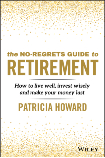
This is an edited extract from The No-Regrets Guide to Retirement: How to live well, invest wisely and make your money last by Patricia Howard (Wiley, $29.95), republished with permission.
 About Patricia Howard
Patricia Howard is a financial planner, having worked for almost two decades building her own financial planning practice Patricia Howard Financial Planning. Patricia was also a finance journalist for The Australian newspaper, the Australian Financial Review and the Age newspaper. She is also the author of The No-Regrets Guide to Retirement: How to live well, invest wisely and make your money last.
Cover image source: MakanaCreative (Shutterstock.com)
Thanks for visiting Canstar, Australia’s biggest financial comparison site*

This article was reviewed by our Editorial Campaigns Manager Maria Bekiaris before it was updated, as part of our fact-checking process.
Try our Superannuation comparison tool to instantly compare Canstar expert rated options.