






NBN plans will increase by up to $10 per month – or $120 a year – for some households from 1 July 2026, as retailers pass through NBN Co’s annual wholesale price rises.
Telstra and Optus, two of Australia’s largest telcos, have confirmed price increases on their two slowest plans (NBN 25 and NBN 50), while several other providers have announced similar monthly rises of up to $10.
NBN Co’s ongoing network investment and upgrades are driving higher wholesale costs, which adjust annually on July 1, which typically trigger retail price adjustments.
Although wholesale prices generally move in line with inflation, retail increases are often larger as providers factor in their own operating costs.
NBN price changes | |||
|---|---|---|---|
Provider | Max | Provider | Max |
Telstra | +$4 | iiNet | +$5 |
Optus (from 6 July) | +$4 | More | +$4 |
Aussie Broadband | +$10 | iPrimus | +$3 |
MyOwnTel | +$10 | Belong | +$3 |
Superloop | +$6 | Dodo | +$2 |
Flip | +$6 | Tangerine (NBN | -$5 |
Tangerine | +$6 | More (NBN | -$5 |
More | +$5 | ||
Source: Canstar
For more updates on NBN price increases, see Canstar’s NBN price tracker.Changes to basic plans could leave vulnerable households paying too much
The price rises come as the ACCC, which is responsible for regulating access to the NBN, proposes changes to the ‘Entry Level Offer’, the basic plan retailers are required to make available.
Originally set at 12/1 Mbps (a minimum download of 12 Mbps, and upload of 1 Mbps), the Entry Level Offer shifted to 25/5 Mbps last year, and is proposed to increase to 25/10 from 2027.
As a result, these low‑speed plans have become increasingly scarce, with providers such as TPG and iiNet recently adding to the list of providers removing them entirely.
Losing access to these lower‑speed plans means light‑usage households, particularly older Australians and vulnerable customers, may be forced onto faster, more expensive plans that exceed both their needs and their budget.
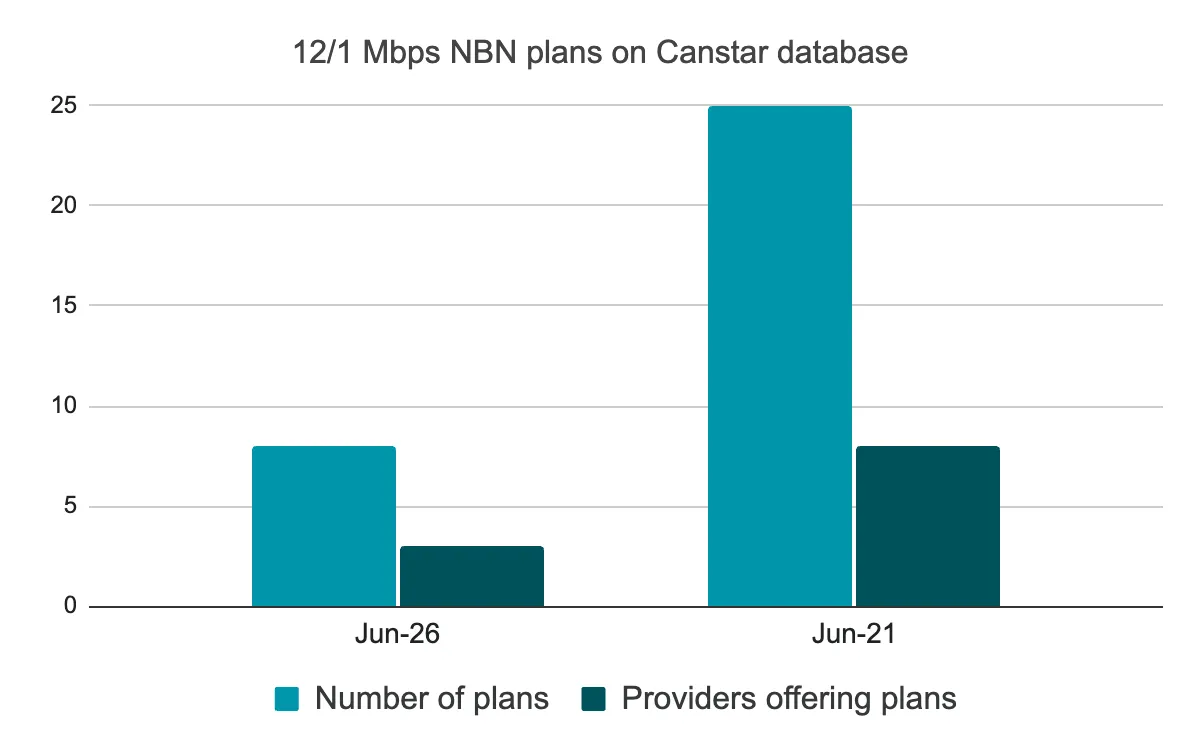
Currently, only three providers in the Canstar database still offer a total of eight 12/1 Mbps plans, down from eight providers offering a total of 25 plans in 2021.
Finding a good value NBN plan and getting the best out of it
While most households receive speeds close to their plan’s maximum, ACCC data shows some customers – especially those on Fibre to the Node (FTTN) – are not achieving the speeds they pay for, with 6.3% of higher‑speed connections classified as underperforming.
Outdated equipment, cables or technology is often the cause. To access higher speeds, households may need a newer modem or router supporting WiFi 6 or WiFi 7.
The ACCC has urged retailers to notify customers if their FTTN connection cannot reach their chosen speed, allowing them to consider a more suitable plan, or a free fibre upgrade where available.
Tips to manage the increase
- Compare plans: Review your current data and speed requirements. If you are paying for an NBN 100 plan but only use the internet for basic browsing and standard streaming, downgrading to an NBN 50 plan could easily offset the price hike.
- Go on a honeymoon: Many providers offer intro discounts for new customers, typically lasting six to 12 months.
- Check your connection type: If you’re on an FTTN connection, ask your provider whether a free FTTP (Fibre to the Premises) upgrade is available at your address. It may unlock faster speeds at no extra installation cost.
- Check your equipment: To reliably access higher speeds throughout your home, ensure your modem or router supports at least WiFi 6 technology.
Canstar's Managing Editor, Utilities and Finance, Tara Donnelly, says, “With household budgets already stretched to the limit, paying extra for the exact same internet connection is going to sting. But Aussies shouldn’t just sit back and pay the loyalty tax.”
“Before these July price hikes take effect, it is crucial to test your actual home internet performance. Call your provider, ask if your address is eligible for a free fibre upgrade, or take your business to a retailer that genuinely delivers the value you're paying for.
“Take these price hikes as a great reminder to review your actual household usage. If you’re paying for premium speeds but only doing everyday browsing, consider dropping down a speed tier – or moving to a provider offering six-month sign-up discounts. This move could easily absorb this price hike and keep more money in your pocket.
“While nobody likes a price hike, paying more for an underperforming connection is even worse. More than 6 per cent of homes on some of the fastest plans are not receiving the speeds they’re paying for, largely due to older FTTN connections or outdated modems.
“As basic, low-speed 12 Mbps plans disappear from the market, vulnerable households, or those that don’t use too much internet, face a double whammy: their current plans are going up in price, and they risk being forced onto faster, more expensive plans that could exceed both their needs and their budgets.
“Take 10 minutes to check your internet speed, evaluate your router, and see if you’re eligible for a free fibre upgrade. If your telco is going to raise your bill, make sure you are getting every bit you pay for.”