


Millions lost to offset errors: How to check your mortgage is saving you what it should

 29 July 2026
Borrowers with a mortgage offset should check their account is working as intended after an ASIC investigation found bank errors have cost customers millions of dollars.
The ASIC report found $55 million was paid in compensation to impacted customers across the eight banks investigated by the corporate watchdog in the two years through to August 2025.
The investigation found shortcomings in how offset accounts were set up and operated across the banks investigated including whether:
- a customer had requested an offset account;
- it was linked correctly; and –
- it was offsetting interest charges correctly.
Why it matters
Offset accounts are an extremely popular mortgage feature, with RBA data showing 55% of mortgages have one attached. A total of $349 billion is stashed in these accounts collectively (APRA), offsetting the interest banks charge borrowers on their home loans – a record high in both dollar and percentage terms. Money in offset accounts has risen by 53% since the start of the rate hikes in 2022 as borrowers try to offset the pain of rising rates.
Offset accounts and balances in Australia
← Mobile/tablet users, scroll sideways to view full table →
| % of mortgages with an offset account |
55% |
|---|---|
| Total in offset accounts |
$349.1 billion – record high |
| % of all credit outstanding |
13.2% – record high |
| Change in last year (Mar 25 – Mar 26) |
+$42 billion (+13%) |
| Change in last 4 years (Mar 22 – Mar 26) |
+$121 billion (+53%) |
Source: APRA, RBA.
What is an offset account?
An offset operates like a normal transaction account, with a debit card and ATM access. However, unlike a normal transaction account, any funds in it, ‘offsets’ the remaining balance you owe on your mortgage for interest calculation purposes.
For example, $50k in an offset would reduce the net balance owing on a $600k loan down to $550k, meaning you’d only pay interest on the $550k balance rather than the whole $600k.
Compare home loans with offset accounts
How can customers check if their offset account is linked properly?
For starters, check with your lender either by calling or logging on to your banking app or online platform.
It’s also worth doing the maths yourself. Here’s how to do a rough estimate:
- Calculate your net balance. That is, the amount you owe on your loan, minus the money in your offset account. If your offset account balance and money owing varies in the month, do an estimate.
- Work out your daily rate. This is your annual mortgage rate (typically around 6.26%) divided by the number of days in the year (365).
- Multiply this by your net balance. This is how much your bank is charging you in interest a day. To work it out over a month, times it by the days in the month.
Example calculations on a $600k loan with $50k in offset
← Mobile/tablet users, scroll sideways to view full table →
| Net balance |
$600,000 – $50,000 |
= $550,000 |
|---|---|---|
| Daily rate |
0.0626 (6.26% p.a.) ÷ 365 |
= 0.017% |
| Daily interest charge |
$550,000 x 0.00017 (0.017%) |
= $94 per day |
| Monthly interest (June) |
$94 x 30 days |
= $2,830 |
Source: Canstar. Note: calculations are estimates for illustrative purposes only. Monthly offset balance of $50k on average throughout the 30-day month. Does not factor in any principal paid towards the loan. Assumes the interest rate remains constant.
How much interest is money in offset accounts saving us?
Canstar analysis shows Australians save an estimated $61 million a day by having this money in their offset accounts.
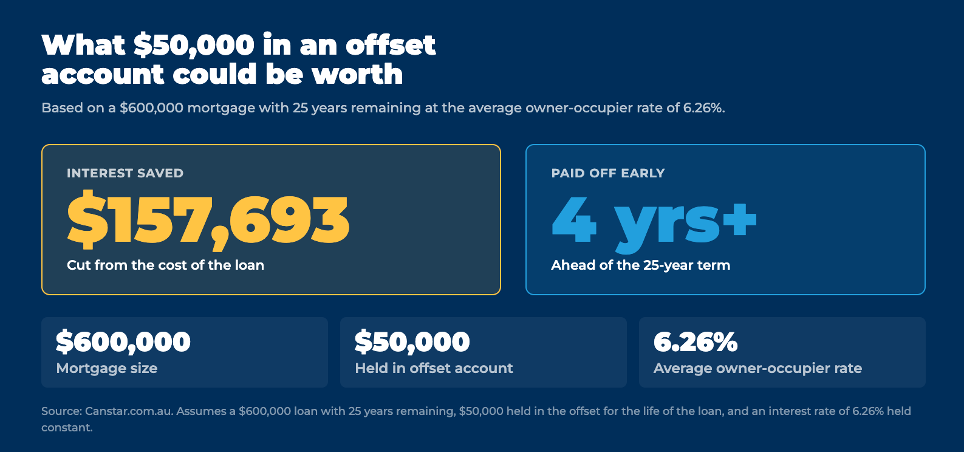
For a typical borrower with a $600,000 mortgage, 25 years remaining on the loan, and $50,000 held in an offset account, the potential savings can be significant.
Assuming the average owner-occupier interest rate of 6.26%, the offset account could reduce the interest paid over the life of the loan by more than $157,693 and pay the loan off more than four years early.
This assumes they keep the $50,000 in the offset for the remainder of the loan and use that money to pay the balance in full at the end of the term. Note this doesn’t factor in rate changes.
However, the true value of an offset account depends on the cost of accessing this feature. If the borrower is paying a significantly higher rate or excessive fees, and doesn’t keep much money in the account, it would eat into the benefit of having an offset, and, in some cases, end up being a more costly option than if they didn’t have one at all.
Offset accounts can cost more, but they don’t have to
Many lenders charge a premium for an offset account through higher fees and sometimes higher rates. However, borrowers shouldn’t assume they need to pay a premium. Canstar data shows:
- 45% of lenders offer offsets on their lowest advertised variable rates, including CBA, ANZ, Macquarie, and Bendigo Bank.
- Four of the seven lowest variable home loan rates on the Canstar database include an offset account.
- A handful of lenders offer an offset account at no extra cost – that is, the account is available on their lowest rate variable loan and they don’t charge any annual or monthly fees on this loan.
Canstar’s Data Insights Director, Sally Tindall, says, “Australians love a good financial hack and for borrowers, offset accounts are right there at the top of the list.”
“For many customers, it’s one of the most powerful tools borrowers have to reduce the amount of interest they pay on their mortgage, but only if it’s working as intended.
“ASIC’s report is hugely concerning. Customers trust their bank to apply interest charges correctly on what is typically their biggest monthly expense. Banks need to have robust processes in place to make sure they’re doing this correctly in all circumstances.
“The report is a disappointing but important reminder that borrowers shouldn’t assume everything is ticking along in the background.
“When you’ve spent years building up savings in your offset, the last thing you want is for those dollars to be sitting in an account that’s not actually reducing your interest bill.
“If you’re one of the 55 per cent of mortgage customers utilising an offset account, check you’re not getting overcharged by your bank.
“Log on to your banking app or your online portal and check the account is clearly listed as linked. But don’t stop there, do some quick maths to make sure the interest you’re being charged is on the amount you actually owe, factoring in the offset balance.
“Customers shouldn’t have to go this far, but what the ASIC report highlights is that it’s worth doing this double check. One option is to get a trusted advisor such as your mortgage broker or accountant to check for you.
“If the maths doesn’t stack up, reach out to your bank and present them with your figures. If you formally raise a complaint, your bank must reply within 30 days. If you still aren’t satisfied with the result, you can escalate it to the Australian Financial Complaints Authority (AFCA), which will act as an independent mediator at no charge to you.
“Even if your offset account is operating correctly, it’s worth checking you’re not overpaying for the account through a higher interest rate and/or fees. While this kind of home loan feature has traditionally come at a cost, competition in the market has helped even out the playing field among those mortgages that offer an offset and those that do not.
“These days, 45 per cent of lenders on the Canstar database offer an offset account on their lowest variable rate loans while a handful charge no additional fees as well.”

This article was reviewed by our Finance Writer Nick Whiting before it was updated, as part of our fact-checking process.