







Energy and fuel costs are the biggest cost pressures facing small business owners right now, new Canstar research has revealed, but looking ahead the majority plan to raise staff wages and are confident in the future of their business.
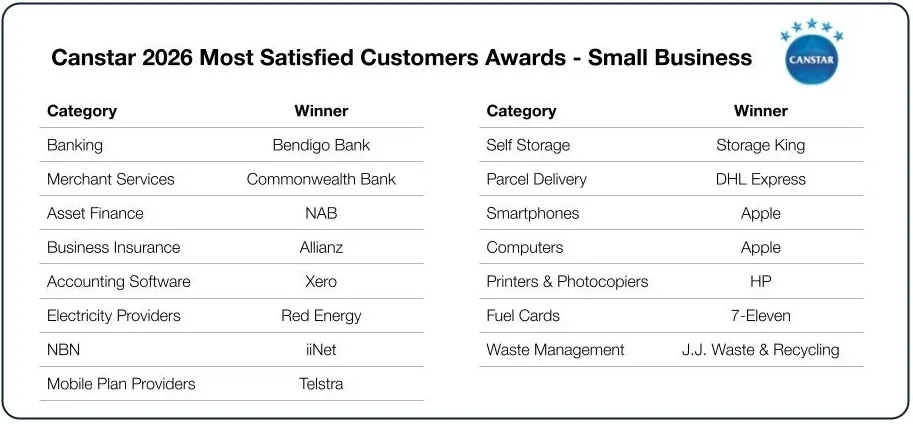
The survey, of more than 2,000 small business owners, also determined the winners of 15 different categories for Canstar’s 2026 Most Satisfied Customers Awards for Small Business, from insurance and banking, to parcel delivery and accounting software.
Energy biggest cost pressure for small business
The cost of energy tops the list of financial pressures for small business owners, according to the survey data, followed closely by fuel, insurance and lease expenses:
- Energy costs (electricity/gas) - 39%
- Fuel costs - 35%
- Insurance costs - 32%
- Rent or lease for business premises - 23%
- Staff recruitment and/or retention - 18%
Business confidence over next 12 months is high
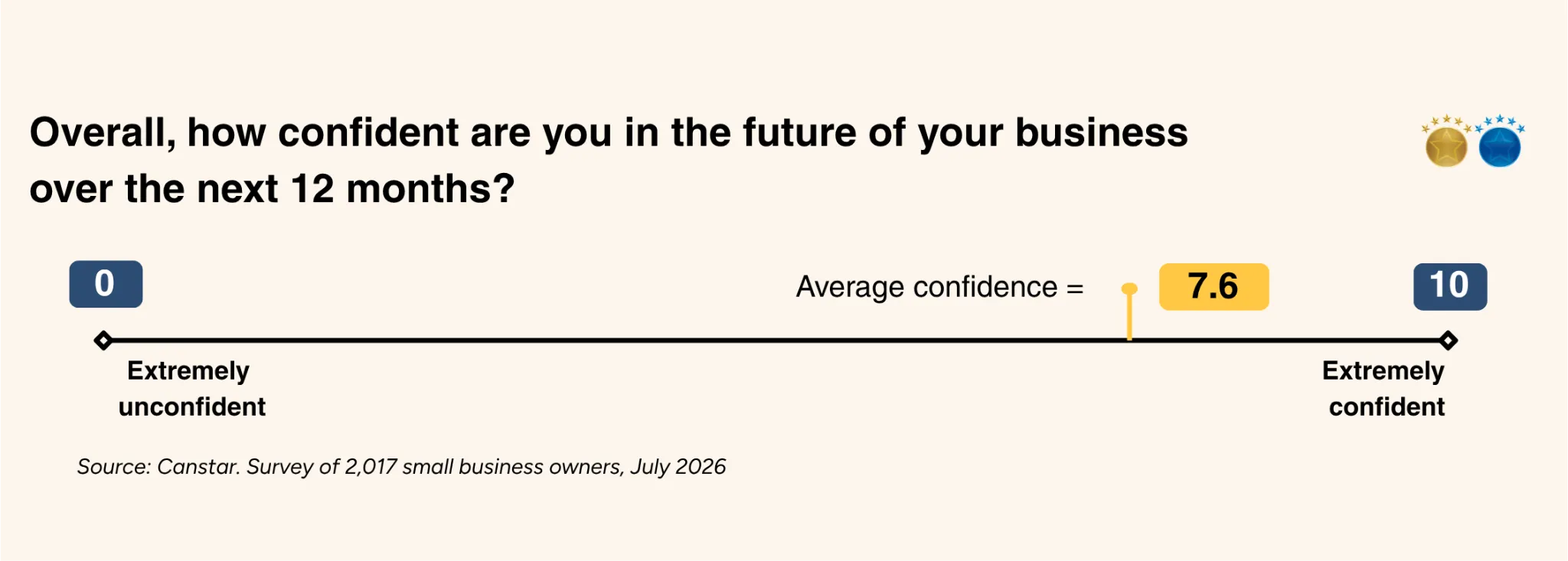
When asked to rate how confident they are in the future of their business over the next 12 months on a scale of 0 to 10, the average score from small business owners was 7.6 out of 10.
This result suggests that despite the headwinds currently making an impact, many see opportunity and optimism ahead.
Merchant services, fuel, top average spend
Small business owners are spending $1,525 a month, on average, on merchant service fees, and $1,003 a month on fuel, according to the self-reported spending data.
Accounting software costs an average of $140 a month, with 34% of respondents saying they’ve spent less on professional accounting fees as a result of using the software.
Average monthly spend for | |||
|---|---|---|---|
Fuel | $1,003 | Business insurance | $281 |
Parcel delivery | $374 | Internet | $149 |
Electricity | $356 | Accounting software | $140 |
Waste disposal | $344 | Mobile plan | $135 |
Self storage | $320 | ||
Source: Canstar, respondents’ average self-reported spend per category. Original $ for business insurance $3,377/year, electricity $1,068/quarter. Respondent sizes: Business insurance = 445, Waste disposal = 280, Self storage = 254, Electricity = 639, Internet = 591, Fuel = 374, Accounting software = 522, Parcel delivery = 574, Mobile plan = 844.
Wages expected to increase – but not all in line with inflation
For those with employees, 85% of employers plan to raise wages in the next 12 months — 22% above inflation, 54% in line with it, 9% below. The remaining 15% won’t raise wages at all.
For those surveyed on mobile plans, 29% said they provide staff with a work mobile device, and 22% upgrade devices every 1–2 years.
However, 20% of respondents to the office tech survey said they wish their employees took better care of their office tech, while 14% of fuel card users said employee misuse was a major business concern.
Businesses could be getting better deals – but many won’t budge
Canstar’s survey data revealed a concerning trend among small business owners: many suspect they could be saving money by switching providers, but are reluctant to do so.
- Mobile: Almost half (48%) have always used the same provider, with 12% citing a lack of time to compare deals, while only roughly half use a dedicated business plan.
- Merchant services: 44% stick with their current provider, yet 26% acknowledge they could likely find a better deal and 23% worry about high transaction fees.
- Electricity: only 41% feel they are on a good electricity deal, and only 54% are on a business plan.
- Internet: 30% believe they could get a better deal on internet service.
Sustainability is front of mind – for some
Environmental considerations are increasingly shaping how small businesses operate, from energy sourcing to waste disposal.
- Electricity: Over a quarter (29%) use solar power, while 12% said they opt for green or carbon-neutral energy plans, and 15% have installed a solar battery to maximise solar power.
- Fuel cards: 23% have considered transitioning to electric vehicles for the business.
- Waste management: 60% say it’s important to their business to dispose of waste responsibly, 48% have become more environmentally conscious over the past few years and just over one-quarter (26%) use an e-waste recycling service for old electronics.
Reliability and service key drivers of satisfaction, over price – in select categories
The feedback from small business owners in Canstar’s survey revealed that when it comes to satisfaction, it’s not always a race to the bottom.
For many, reliability and performance outweigh the price when it comes to satisfaction – particularly for services such as parcel delivery and internet.
However, for the categories of electricity and waste management, value for money far outperformed when it came to what small business owners prioritised for satisfaction.
Canstar's consumer expert, Eden Radford, says, “This research shows the climbing cost of energy and fuel is having an impact on small businesses, but that many are resilient, with owners reporting a largely-confident outlook ahead.”
“From sole-traders to operations with 100 or more on the pay roll, small businesses comprise 97 per cent of Australia’s economy and play an incredibly important role in the growth of this country.
“So many small business owners are incredibly busy, however, this research has shown that busyness may just be getting in the way of savings. Taking the time, where possible, to compare and shop around could free up much-needed cash flow.
“Some businesses are using consumer-focused plans, which may mean they’re paying more than they need to, or missing out on optimisations that could make a real impact. Looking at tailored business options could deliver long-term savings that offset rising overheads.
“Our analysis has shown that when it comes to services like internet and parcel delivery, small businesses place a premium on reliability over the lowest price, which makes sense when you consider downtime costs far more than the service itself.
“However, the prioritisation of price is at play for things such as power and waste, where businesses are focused on getting the best price for the job.”