






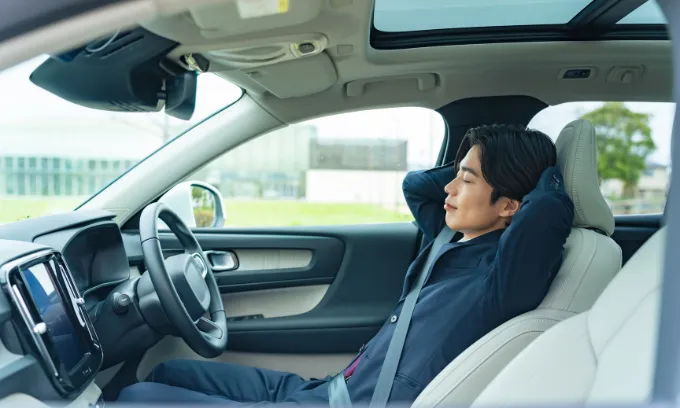
You’ve likely become accustomed to some form of automation on the road through Advanced Driver Assistance Systems features, things like lane keep assist, cruise control and park assist.
All legal, and all helpful. But what if your car could change lanes, merge onto a freeway or handle Melbourne’s infamous hook turns, and possibly save money on your car insurance?
Sounds like something out of a sci-fi blockbuster. Yet it’s already happening on Australian roads.
Are driverless cars legal in Australia?
Short answer, not quite. Fully automated vehicles that can drive without a human in control aren't currently permitted on Australian public roads.
But ones where the driver is still responsible, sitting behind the wheel fully alert and able to take control if needed, are.
One of the most advanced options available in Australia is Tesla’s Full Self-Driving (Supervised), which is available as a subscription for select Tesla models.
According to RACV, the system can handle complex driving tasks like negotiating intersections and roundabouts to freeway merges. But, crucially, you remain responsible for the car.
And Australians are using it.
Since Tesla launched Full Self-Driving (Supervised) in Australia in October 2025, Tesla says local drivers have clocked up more than 132 million kilometres using the technology, with average daily use increasing more than five-fold since launch.
Could be a win for your wallet?
Typically, EVs cost more to insure than petrol-powered cars, with Canstar research showing EV insurance was almost 26% more expensive on average than an equivalent petrol vehicle in one comparison.
The comparison was based on quotes from a selection of insurance providers for a 45-year-old male living in North Sydney and driving 10,000km a year. The EV used for the comparison was a Kia EV3 Air Standard Range, while the petrol equivalent was a Kia Seltos GT AWD.
However, news out this week is a promising turn of events.
Zurich has announced it’s now offering discounts to Australian Tesla drivers who regularly use the Full Self-Driving (Supervised) subscription.
It says Tesla data shows vehicles using this technology experience seven times fewer major and minor collisions than regular EVs.
If the technology reduces the likelihood of an accident, the thinking is that there may be less risk to insure, which could mean a lower premium.
This is a big shift for car insurance.
Traditionally, car insurance providers have looked at things like your age, gender, driving history, vehicle type, age and value, where the car is kept and how much it is driven.
But increasingly, the technology in your car and how you actually drive it can become part of the equation.
Take ROLLiN’s Safe ‘n Save feature. If you opt in, the app can track things like acceleration, braking and cornering, as well as phone use while driving. You receive a driving score, and a score of 95+ can qualify for a discount of up to 15%, with lower scores getting potential discounts of between 5 and 10%.
That could be particularly interesting for drivers who traditionally get slugged with higher premiums based largely on their age or demographic.
For example, Canstar's 2026 data puts the average comprehensive premium at $3,158 for an under-25 male, compared with $1,451 for drivers aged 50+.
Average annual comprehensive car insurance premiums by age | |
|---|---|
Age | 2026 |
Under 25 female | $2,833 |
Under 25 male | $3,158 |
25 to 29 | $2,367 |
30 to 49 | $1,841 |
50+ | $1,451 |
Source: Canstar. Based on comprehensive car insurance policies rated in Canstar's 2026 Car Insurance Star Ratings. Premiums include quotes for both new and used cars for a range of scenarios, with a state-specific target excess of $800 to $1,000.
This is just the beginning
As cars get smarter and more automated, the old insurance formula could change.
We’re moving towards a world where we’ll need to understand not just the driver, but the technology, the vehicle’s capabilities and how those systems perform in the real world.
Fully driverless cars might still be a way off in Australia. But the future of car insurance? It’s already driving towards us.