







ANZ has scaled back the sign-up perks on its popular Frequent Flyer Black and Platinum cards ahead of the RBA’s ban on surcharging.
Yesterday, ANZ reduced the Qantas sign-up bonus points on its Frequent Flyer Black card from a maximum of 130,000 to 80,000 and scrapped the $200 cashback offer.
ANZ’s Frequent Flyer Platinum sign-up bonus has dropped from 75,000 Qantas points to just 40,000, with the $100 credit also axed.
ANZ sign-up | |
|---|---|
Card | Key changes |
ANZ Frequent Flyer Black |
|
ANZ Frequent Flyer Platinum |
|
Source: Canstar. Changes effective 22 July, for new customers only.
NAB has also announced an overhaul of its white labelled rewards cards – MyCard, BOQ and Virgin Money – with changes to interest rates, annual fees, earn rates and burn rates.
The bank has said the rewards re-structure is in response to the surcharge ban, with the credit card changes to come into effect on the same day as the ban: 1 October.

One of the biggest changes announced so far is to the points program offered by MyCard (previously Citi).
The number of MyCard points needed to redeem a reward (i.e. the burn rate) will jump by up to 62% in some cases, significantly downgrading the value of points earned, although existing customers will get a one-off boost in points to compensate.
NAB white label credit card | |
|---|---|
Card | Key changes |
MyCard Premier Qantas |
|
MyCard Premier |
|
MyCard Rewards |
|
MyCard Prestige |
|
BOQ Platinum |
|
BOQ Blue |
|
Virgin Anytime Rewards |
|
Virgin Velocity Flyer |
|
Virgin Velocity High Flyer |
|
Source: Canstar. Note not all rewards card changes are listed above.
RBA ban likely to push more banks into shaving back reward card perks
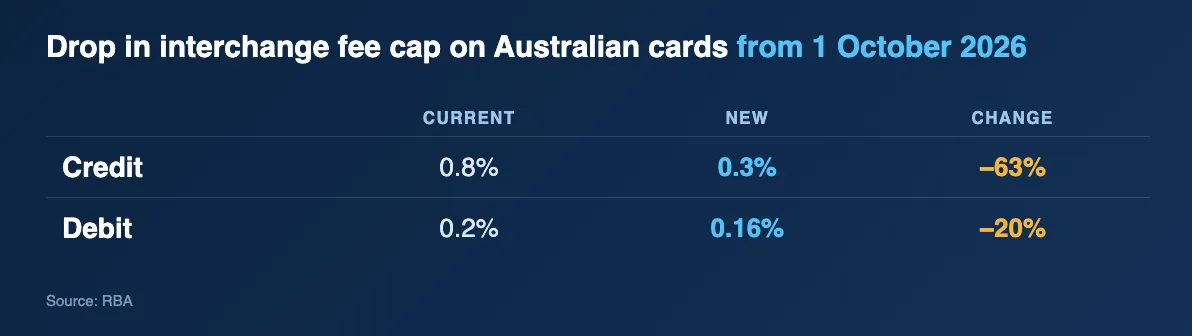
The upcoming ban on credit and debit card surcharges on 1 October, which was initiated by the RBA, includes a reduction in interchange fees – a fee charged at the backend to help facilitate card payments.
The central bank is doing this to reduce the cost of receiving card payments for small businesses who will no longer be able to directly pass this cost on to shoppers.
However, these fees help fund credit card rewards programs, which means there will be significantly less money available for the rewards, perks and complimentary insurances many credit card users have grown accustomed to.
What should credit card customers do?
Watch your inbox for notice of variation emails from your card provider and be on the lookout for three key things:
- A drop in rewards perks: that could be a downgrading of your ‘free’ insurances or no more lounge passes.
- A points squeeze: your card provider might reduce your earn rate, that is, the amount of points you earn per dollar spent, or your burn rate, which is how many points you need to redeem a reward such as a gift card.
- Price hikes: that could be an increase in your interest rate, annual fee or currency conversion fees for international purchases.
If you do get a note from your bank telling you the value of your rewards points is about to take a nosedive, do a check to see if you are still getting bang for buck from your card.
The health check:
- Step 1: Write down how much you paid in fees over the last year.
- Step 2: Check how much interest you’ve been charged in this time.
- Step 3: Log on to your rewards program and calculate the value of points redeemed (rather than collected) in the past 12 months.
- Step 4: Do the equation: the value of points redeemed must be greater than the interest charges + fees paid. Otherwise, your card is getting the better of you.
Are banks still offering decent sign-up points?
Many credit card companies are still offering tens of thousands of points for signing up to a new rewards credit card – at least for now. The Canstar database shows one of the highest is from Westpac on its Altitude Qantas Black card, with up to 150,000 Qantas points on offer.
However, be warned: the points are split over 12 months which means at least two annual fees at $370 a year, plus a 20.99% interest rate on debts that aren’t cleared within the interest-free day period.
Highest frequent flyer | |||
|---|---|---|---|
Provider | Max sign | Rate | Annual |
Westpac, | 150,000 (Qantas or Virgin) | 20.99% | $370 |
Qantas Money | 150,000 (Qantas) | 20.99% | $1,200 |
NAB | 130,000 (Qantas) | 20.99% | $420 |
MyCard | 110,000 (Virgin) | 22.49% | $300 |
Source: Canstar. Note: Select providers only. Westpac offers both Qantas and Velocity Points, while St. George, Bank of Melbourne and BankSA offer Qantas Points only.
Don't assume your rewards will stay the same
Canstar's Data Insights Director, Sally Tindall, says, “The era of generous credit card rewards is starting to lose its shine.”
“ANZ has taken a sizeable chunk of sign up points off the table on two of its most popular cards, while NAB’s recalibration of rewards points on its white-labelled products is a window into the future post-1 October.
“The knock on effect of the RBA’s surcharge ban might leave points chasers with fewer perks in their hands, but it will make the system more equitable.
“Right now we have a system where people who pay for things at the shops with their very boring, perk-free debit cards are getting slugged with a surcharge, and part of that surcharge is going towards perks for those with a credit card.
“If you’ve got a rewards credit card, don’t assume the current value proposition is the one you’ll still have by Christmas. Keep an eye on your inbox for any emails from your provider, because banks should tell you well in advance if they’re making significant changes.
“The quickest way to work out if your card still stacks up is to weigh up what you’ve reaped in rewards over the past year against what you’ve shelled out in annual fees and interest. If the scales aren’t tipping in your favour, it’s probably time to reconsider whether you’re on the right card.
“Rewards cards typically only work if you pay your balance off in full each month. If you’re paying interest, even the biggest points haul is unlikely to make up for those charges.”
Loans to households: | |||
|---|---|---|---|
Amount | Market | Year-on | |
CBA | $7.96b | 29% | +2% |
NAB | $7.58b | 28% | -2% |
Westpac | $5.81b | 21% | -3% |
ANZ | $4.26b | 16% | -3% |
Source: APRA Monthly Authorised Deposit-taking Institution Statistics, May 2026, released 30 June 2026, prepared by Canstar.