






From today, Australians will no longer have to pay an extra fee when using their debit or credit card, as RBA reforms bring an end to card surcharging.
Visa, Mastercard and eftpos have today prohibited merchants from adding a surcharge to credit, debit and prepaid card payments.
American Express has also announced it will ban surcharging from today, while PayPal’s no-surcharge rule takes effect next Monday.
What does the surcharge ban mean for consumers?
For consumers, one of the biggest changes will be greater transparency at the checkout.
Instead of seeing a card surcharge added after the advertised price, shoppers should know upfront how much they are going to pay.
However, while the RBA has said Australians previously have paid $1.6 billion a year in card surcharges, the removal of these fees doesn’t mean every shopper will pay less, because some shops that previously charged a surcharge may choose to incorporate some of the cost into higher prices.
Who will be policing the surcharge ban?
Interestingly, it won’t be the ACCC that polices these new rules. Because the ban has been implemented by the card network providers, that is, Visa, MasterCard and Amex, it will be up to them to manage. If using eftpos, it’s up to the bank that issued the card.
In the first instance, however, shoppers that believe a store has applied a surcharge incorrectly should raise it with the shop first.
Will this be the death of cash?
The removal of card surcharges could encourage more people to pay electronically. A previous Canstar survey of 3,001 Australians found 33% try to pay with cash when a shop charges a surcharge. These shoppers could switch back to paying by card.
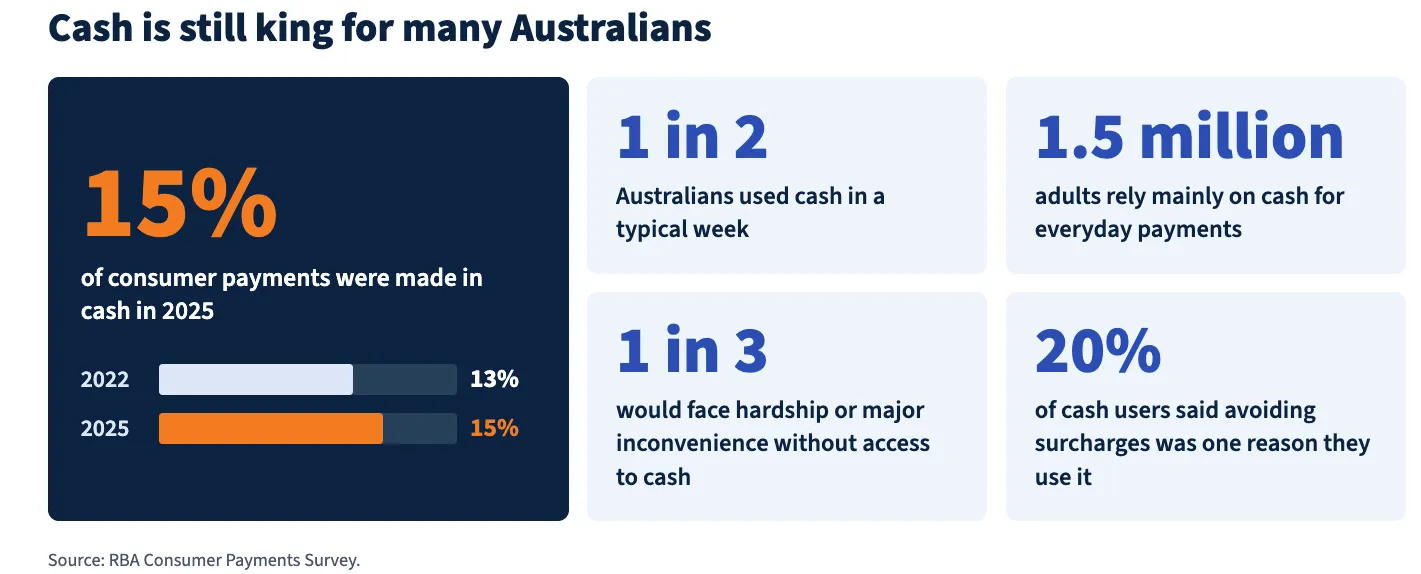
However, this won’t be the end of cash. Shops who want to encourage customers to pay by cash to help them reduce the cost of accepting electronic payments, might start offering discounts for paying with notes and coins, a perfectly legitimate practice, according to the RBA.
While it’s not mandatory for shops to accept card payments, it is mandatory for certain stores to accept cash, as a result of new rules introduced on 1 January 2026.
At the start of the year, the federal government made it compulsory for big retailers (turnover of $10m+) to accept cash for essential goods and services costing $500 or less between the hours of 7am and 9pm.
A recent RBA Consumer Payments Survey found cash is on the rise, not the decline, with the proportion of people paying with cash increasing from 13% in 2022 to 15%.
What about credit card rewards?
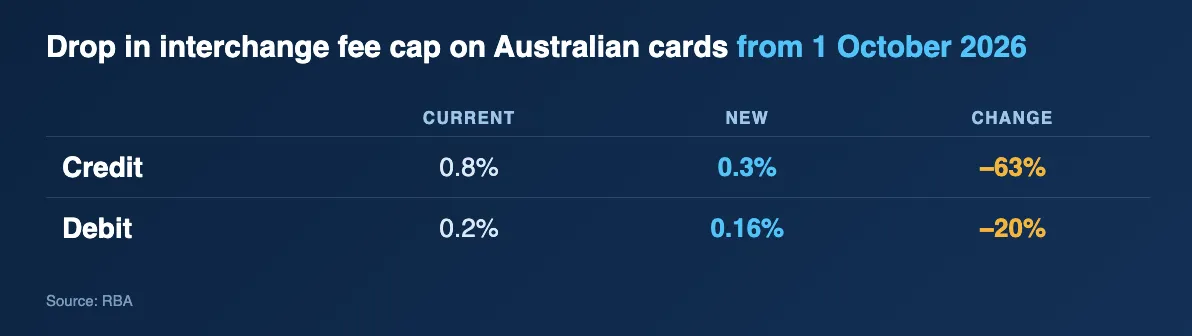
As part of the overhaul, the RBA has today dropped the maximum amount banks can charge payment providers for each transaction they facilitate, to help reduce the burden on small businesses.
The new cap on debit cards has dropped by 20%, while the cap on credit card interchange fees has dropped by 63%.
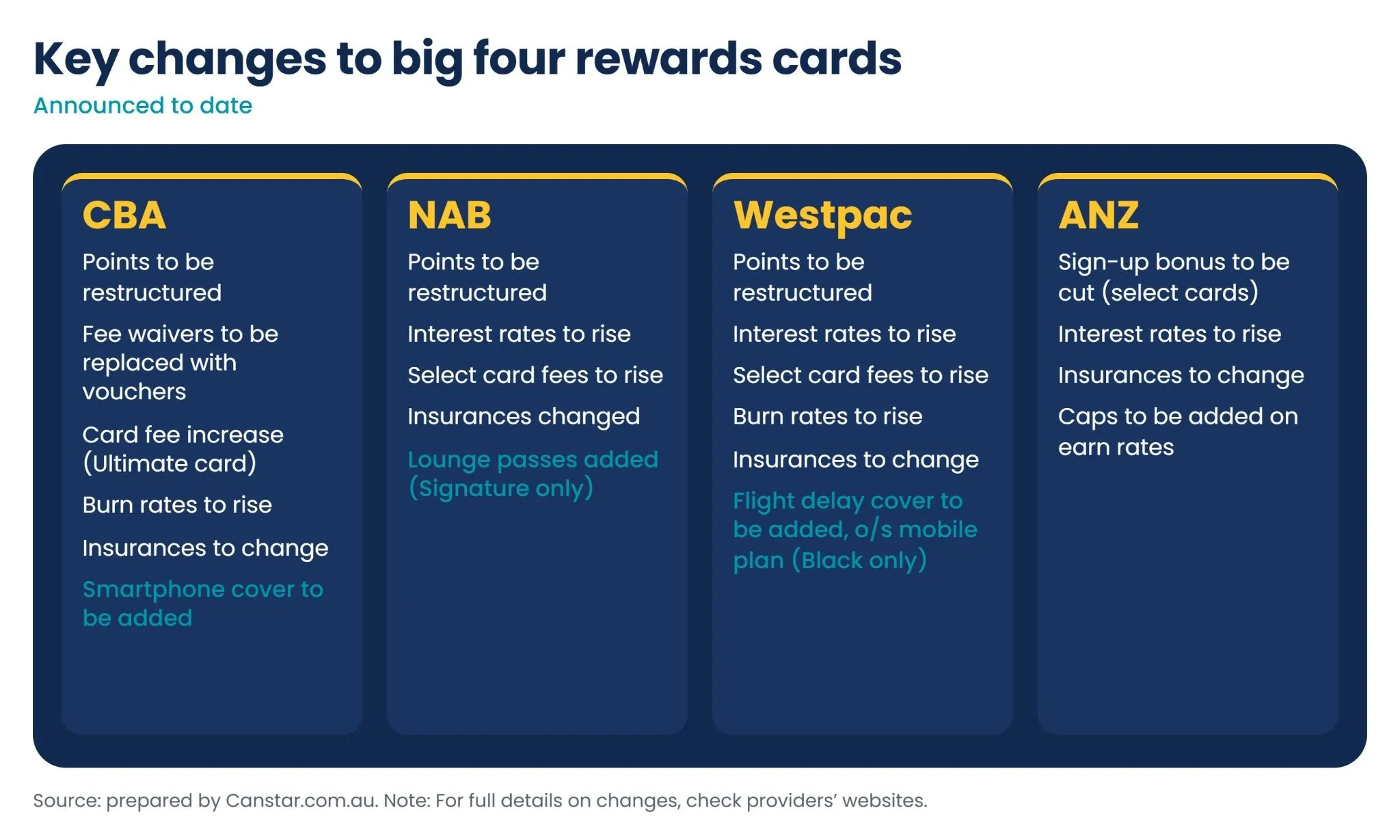
This money helps fund credit card rewards programs and, as a result, many banks have made significant changes to their card programs.
A summary of the key card changes can be found here.
While the overhaul could push some customers into ditching their credit cards, it’s unlikely to spell the end of the 11.5 million credit card accounts currently in circulation.
Credit cards are big money makers for the providers. RBA domestic banking fee data shows credit cards are the biggest generator of bank fees from Australian households, collecting an eye-watering $1.7 billion in 2024-25, up 10% from the previous year.
Interestingly, some banks are still posting highly competitive sign-up offers designed to attract those now on the hunt for a more competitive credit card, including up to 200,000 rewards points and up to 150,000 frequent flyer points.
However, it is a case of buyer beware. These types of cards can be very expensive with high rates, high fees (some as high as $1,200 a year), and plenty of fine print to qualify for the extra points.
Anyone considering a new credit card with a sign up bonus should be very careful they pick the right card for their finances.
Some of the highest sign up rewards points cards on Canstar | ||||
|---|---|---|---|---|
Provider | Card | Max sign up points | Rate | Ongoing card fees |
St George + others | Amplify Signature card | 200,000 (over yrs 1 + 2) | 23.98% | $370 |
Westpac | Altitude Rewards Black | 200,000 (over yrs 1 + 2) | 23.98% | $370 |
NAB | Rewards Travel card | 180,000 (over yrs 1 + 2) | 22.49% | $395 |
MyCard | Premier | 150,000 (over yrs 1 + 2) | 22.49% | $300 |
ANZ | Rewards Platinum | 125,000 (over yrs 1 + 2) | 22.49% | $149 |
Source: Canstar. See notes below.
Some of the highest sign up frequent flyer points cards on Canstar | ||||
|---|---|---|---|---|
Provider | Card | Max sign up points | Rate | Ongoing card fees |
St.George + others | Amplify Signature Qantas | 150,000 (over yrs 1 + 2) | 23.98% | $450 |
Qantas Money | Titanium | 150,000 (over 90 days) | 20.99% | $1,200 |
Westpac | Altitude Black Velocity/Qantas | 150,000 (over yrs 1 + 2) | 23.98% | $450 |
AMEX | Qantas Ultimate | 120,000 (over yrs 1 + 2) | 23.99% | $450 |
Source: Canstar. Rates, fees, and points accurate as at 1 October. Providers include St George, Bank of Melbourne, BankSA. Card fees include annual fees, monthly fees, rewards program fees but not fees such as international transaction fees and late payment fees. Sign-up offers list points but does not list sign-up fee waivers, fee reductions, cashback and ongoing perks. Spend and other requirements apply for sign up pts. See card websites for full details and consider whether a card is right for your financial needs.
Shoppers can't assume this means they’ll start paying less
Canstar’s Data Insights Director, Sally Tindall, says, “Australians can finally stop paying a penalty for choosing to pay by card.”
“For years, consumers have been hit with an extra fee simply for using the payment method of their choice. From today that is changing.
“The big win here is certainty. If the price on the shelf says $100, consumers should be able to pay $100 without a surprise fee appearing at the checkout.
“However, shoppers shouldn’t assume today’s surcharge ban means they’ll now start paying less. Businesses still have to pay to accept card payments, so some may choose to build those costs into their prices instead.
“The RBA’s capping of card interchange fees, which starts today, will hopefully see the cost of accepting card payments reduce significantly, however, it could require some businesses to shop around in order to get a better deal – yet another admin task for many small businesses that are already up to their eyeballs in paperwork.
“The banks have also made it clear they’re not willing to wear the loss that comes from the reduction in interchange fees, with, in some cases, significant changes to their credit card programs now underway.
“Points chasers will be pleased to know there are still around 40 cards on the Canstar database offering extra points on sign up.
“Just be careful to read the fine print, because so often you have to have the card for a full 12 or 13 months in order to get the maximum sign up benefit, which obviously means two rounds of annual fees.
“It’s also important not to chase points just for the sake of it, particularly if you’re someone who stockpiles instead of using them. What’s more important is to get a card that fits your finances, or, alternatively, consider ditching credit altogether.
“These days, a debit card does pretty much everything a credit card does, except get you into debt.”