







Pet owners are feeling the pinch with the cost of veterinary services rising by 9% over the past two years, according to the latest ABS Consumer Price Index data.
A new Canstar survey of over 2,000 Australian pet owners found 45% would struggle to pay or need to consider a loan if their pet required an unexpected vet procedure costing $3,000 or more.
More pet owners are managing this cost by taking out pet insurance, with 35% of owners now holding a policy, up from 23% last year.
The problem is, the cost of cover is also rising, with Canstar research showing premiums over the past year have increased by 26% for dogs and 27% for cats.
Change in average annual pet insurance premiums for accident & illness cover | |||
Pet | 2025 | 2026 | Change |
Small dog | $1,316 | $1,580 | +$264 (+20%) |
Medium dog | $1,323 | $1,693 | +$370 (+28%) |
Large dog | $1,423 | $1,834 | +$411 (+29%) |
Overall dog | $1,359 | $1,718 | +$359 (+26%) |
Cat | $776 | $986 | +$210 (+27%) |
Source: Canstar. Based on accident & illness pet insurance products rated in Canstar's Pet Insurance Awards. Quotes for a range of breeds, ages and excesses. Small dog category ex. French Bulldogs.
Some breeds cost more
The breed of your pet will impact the cost of insurance, with some breeds more susceptible to certain health conditions than others.
For example, a cavoodle is among the cheapest breeds to insure for accident and illness cover, while insuring a French Bulldog for the same level of cover can cost upwards of $4,000 a year on average.
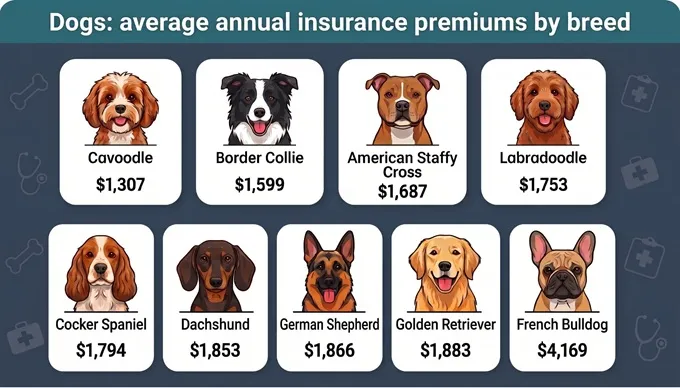
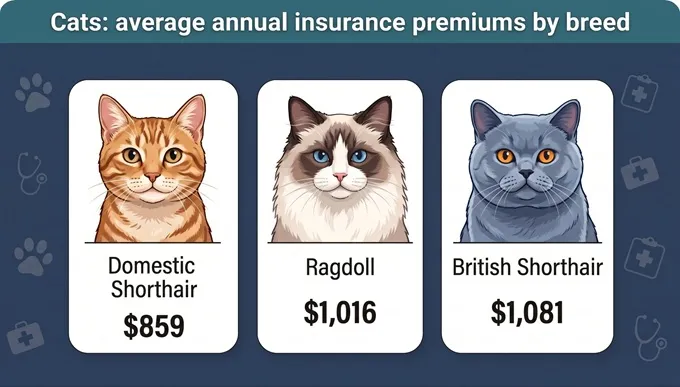
Source: Canstar. Notes: Based on accident and illness pet insurance products rated in Canstar's 2026 Pet Insurance Awards. Quotes for a range of breeds, ages and excesses.
Shopping around could save hundreds
One of the biggest ways to save on pet insurance, for those who want cover, is shopping around.
Canstar compared pet insurance policies from 26 insurers, finding dog owners opting for one of Canstar’s top-rated providers, instead of an average-priced provider, could save up to 42% over the next year.
Potential savings in annual pet insurance: Accident and illness cover | |||
Pet | Market average | Award winners average | Difference |
Small dog | $1,580 | $1,013 | -$567 (-36%) |
Medium dog | $1,693 | $1,010 | -$683 (-40%) |
Large dog | $1,834 | $1,071 | -$763 (-42%) |
Overall dog | $1,718 | $1,034 | -$684 (-40%) |
Cat | $986 | $651 | -$335 (-34%) |
Source: Canstar. Based on accident and illness pet insurance products rated in Canstar's 2026 Pet Insurance Awards (Aug 2026). Quotes for a range of breeds, ages and excesses. Small dog category excludes French bulldogs.
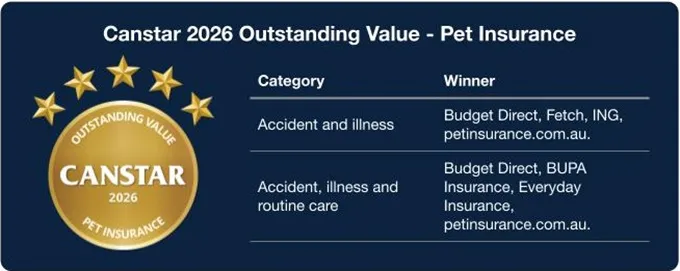
Canstar’s Outstanding Value Pet Insurance Awards highlight the providers offering value for money.
To be in the running, pet insurance providers must offer policies with an annual benefit limit of $10,000 or over and cover for up to 80% or more of eligible vet bills per year.
Canstar identified six winners in the 2026 awards:
What to consider before taking out cover
Pet insurance can help cover some of the costs associated with veterinary care, particularly unexpected bills.
However, it won’t necessarily cover the full cost of a vet bill. When considering whether pet insurance is right for you, it’s worth looking at:
- Level of cover: The types of vet expenses included in pet insurance can vary significantly. Policies typically require customers to pay a portion of the bill, which in some cases can be as much as 40%. Claims can often be subject to annual limits and other conditions.
- Your pet’s age and health: Taking out cover when your pet is younger may give you more options, as conditions that develop before you take out a policy may be considered pre-existing and excluded from cover.
- Pre-existing conditions: If you switch insurers, existing conditions may not be covered by your new policy.
- Breed-specific conditions: Check whether sub-limits or exclusions apply to conditions associated with your pet’s breed.
Canstar's data insights director, Sally Tindall, says, “With veterinary costs rising, pet owners need to think carefully about how they’ll manage these expenses before an unexpected bill lands.”
“Our research shows illness is the most common reason for pet insurance claims, and unlike routine care, it’s something that can be difficult to plan for.
“Pet insurance can be one way of managing this risk, but it’s important to remember that you’re typically paying for the cover as well as a portion of the vet bills themselves.
“With premiums averaging around $1,700 a year for dogs and under $1,000 for cats, shopping around can make a real difference to the overall cost. Our research shows opting for one of our award winning insurers could potentially save pet owners up to 42 per cent compared to an average-priced provider.
“However, as with any insurance, it shouldn’t be a race to the cheapest policy. Look at what’s included in the policy, how much of an eligible vet bill the insurer will cover and the annual limits.
“Understanding whether the limits apply per claim, per condition and, or, per year, can also help avoid an unwelcome surprise when you need to claim.”