





The rise in Australia’s unemployment rate to 4.9% cements the case for a pause at the RBA’s final Monetary Policy Board meeting in December.
The jump from 4.7% to 4.9% in the ABS Labour Force seasonally-adjusted figures, released today for October, takes the country’s unemployment rate to a five-year high.
The number of employed people dropped by approximately 43,500.
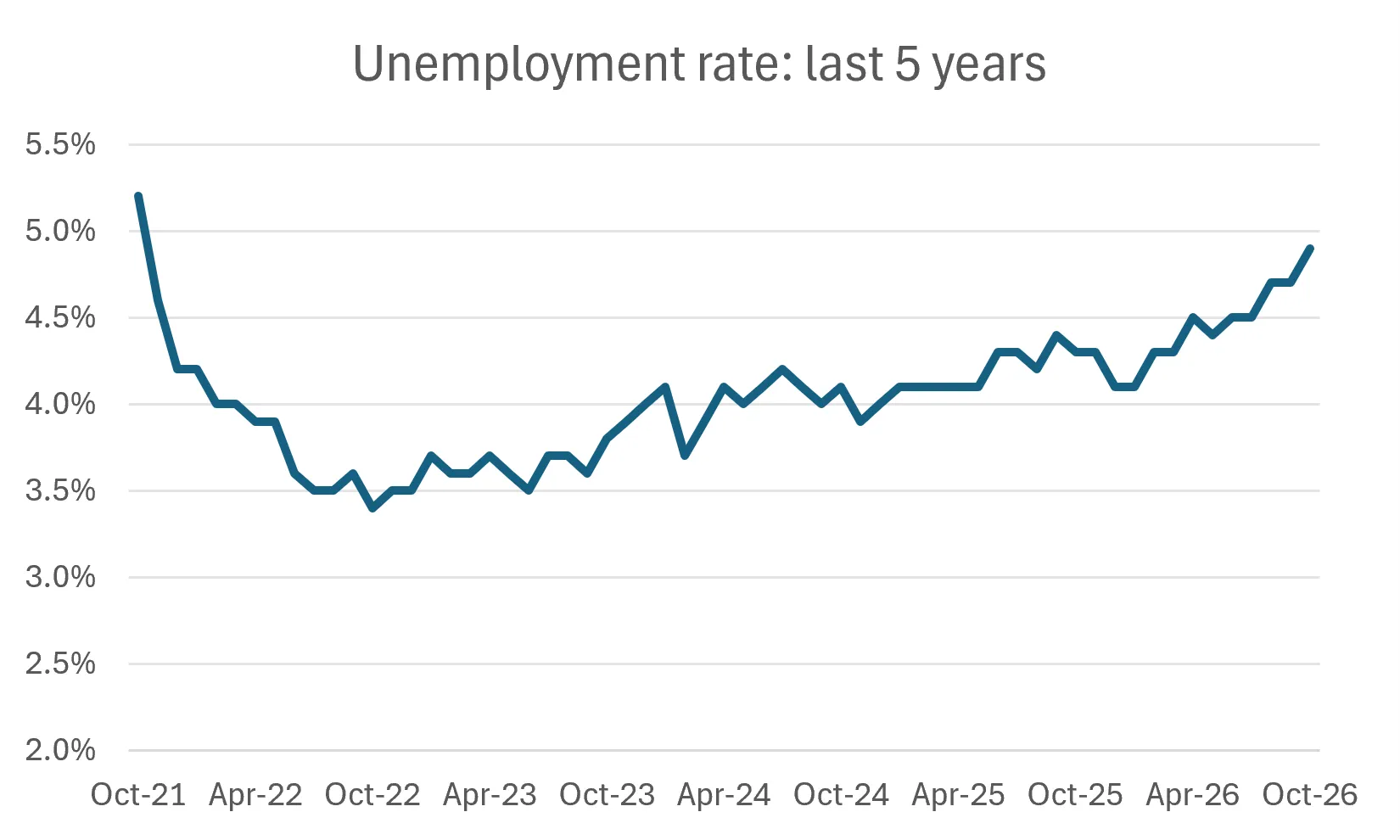
Today’s result is tracking above the RBA’s unemployment year-end forecast of 4.7%, which was only recently revised up from its previous forecast in August of an unemployment rate of 4.5%.
Unemployment rate forecast, year-end 2026 | ||
|---|---|---|
RBA Aug forecast | RBA Nov forecast | Oct (actual) |
4.5% | 4.7% | 4.9% |
Source: RBA, ABS.
While this is just one month of data in one dataset, it comes on the back of a hotly-debated cash rate hike just over two weeks ago, where Board members deliberate over the downside risks of a higher cash rate setting and the need to give the 2026 hikes time to flow through the economy.
The RBA already looked to be lining up for a pause in December to close out the year. Today’s result makes this a near-certainty.
Cuts still a long way off
While further cash rate hikes are off the table, at least for now, cuts won’t suddenly appear on the RBA’s agenda.
All four big bank economic teams expect the next move to the cash rate will be down, but CBA, Westpac and NAB don’t expect the first one to come until August, while ANZ doesn’t expect one until next November.
However, if inflation is still uncomfortably out of the target band by mid-next year, cuts may not materialise in 2027 at all.
Big banks’ cash rate forecasts | |||
|---|---|---|---|
Dec meeting | Forecast | Cash rate at end of forecast | |
CBA | On hold | 2 cuts in Aug + Nov 27 | 4.35% |
Westpac | On hold | 4 cuts in Aug + Nov 27, Feb + May 28 | 3.85% |
NAB | On hold | 4 cuts in Aug 27 + Nov 27, May 28 + Nov 28 | 3.85% |
ANZ | On hold | 2 cuts in Nov 27 + Feb 28 | 4.35% |
Mortgage buffers now in the spotlight
With unemployment on the rise, households with no buffer could find themselves in an extremely difficult financial position in 2027.
Data from Australia’s biggest bank, CBA, shows 85% of its mortgage customers are ahead on repayments by an average of 32 months as at 30 June 2026.
While this makes for an impressive buffer for many, this figure has started to slide. Six months prior, the average number of months ahead on repayments was 35.
It’s a tale of two cities when it comes to mortgage buffers, with some customers still building impressive fortresses, while others are having to eat into them.
Westpac’s full-year results show while 37% of its mortgage customers are ahead on repayments by more than 2 years, 28% of its customers have a buffer of less than one month, including 14% that have no buffer.
The latest big four bank results also show arrears are ticking up, with CBA’s Q127 Trading Update showing a rise from 0.73% to 0.80%.
Big four banks’ FY26 results | ||||
|---|---|---|---|---|
CBA | Westpac | NAB | ANZ | |
90+ days arrears | 0.80% | 0.67% | 1.09% | 0.95% |
Borrowers with buffer | 85% | 86% | 86% | 87% |
Borrowers with no buffer | 15% | 14% | 14% | 13% |
Source: Big four FY26 results, CBA: 30 Jun 26, Westpac, NAB, ANZ: 30 Sept 26. CBA arrears data is from Q1 27 trading update. CBA and Westpac is group data, ANZ excludes Suncorp, NAB excludes UBank. Buffer data by accounts. Prepared by Canstar.
Emergency buffer: what you need and how to build one
It’s customers with little or no emergency buffer who need to pull out all the stops now, particularly now unemployment is on the rise.
A good rule of thumb is to have three to six months’ worth of essential living expenses tucked away in case you or your partner loses a job or your circumstances change.
Here’s how:
- Work out where your buffer will sit: The mortgage, as extra repayments, or an offset account, is a great option for borrowers. For others, an at-call savings account can work well. It needs to be accessible, safe, productive and separate from your regular spending.
- Set yourself a target: Three months of expenses is a good initial target, but once you’re there, aim for longer.
- Kick start the fund with some big decisions: That could be selling a couple of big-ticket items, delaying a holiday, or cashing in your bank of rewards points.
- Add to it regularly: Negotiate, switch or cut regular expenses. Work out how much you’ll save each month as a result of these negotiations and set up a monthly automatic transfer.
- Consider taking on extra work: Extra money coming in, even temporarily, can help build up that all-important buffer.
- Know your support options: If bills are becoming difficult to clear, ask your bank and other providers about hardship assistance. Also seek independent financial advice via the National Debt Helpline: 1800 007 007.
The highest level we’ve seen in five years
Canstar's Data Insights Director, Sally Tindall, says, “The cracks in Australia’s labour market are starting to widen with this jump in the unemployment rate to 4.9 per cent, the highest level we’ve seen in five years.”
“This will be uncomfortable reading for a Board that hotly debated the last cash rate hike, with three members voting against the move out of concern for the downside risks.
“The RBA has said unemployment needs to edge higher if inflation is going to come down. Yet today’s result for the month of October has blown past the central bank’s year-end forecast of 4.7 per cent, an expectation that was only recently revised up from its previous forecast in August of an unemployment rate of 4.5 per cent.
“The RBA will not jump at just one month of data, and it certainly won’t be pivoting back to cuts in the near future. However, it does cement one outcome: the Board will not be hiking at its next meeting in December.
“While the RBA still needs to deliver on price stability, it can’t ignore its other mandate to keep Australians in jobs. If unemployment continues to climb ahead of forecasts, further cash rate hikes become extremely unlikely.
“On paper, a 4.9 per cent unemployment rate sits just above the 10-year average of 4.8 per cent and below the 20-year average of 5.1 per cent. In reality, behind those percentages are households with tough decisions to make.
“Servicing a mortgage or paying rent at current interest rates is hard enough; doing it without money coming in is an equation that doesn’t stack up, no matter how many budget cuts are made, unless you’ve got a buffer to fall back on.
“If you’ve got high overheads, take the time ahead of the Christmas spending season to shore up your cash buffer. You want a minimum safety net of at least three months’ worth of expenses. Ideally doube this.”
