





The RBA is expected to crank up the cash rate to 4.85% – the highest level in 18 years – when its Monetary Policy Board meeting wraps up tomorrow.
Australia may be revisiting 2008-era interest rates, but today’s borrowers have far bigger mortgages to contend with.
The average new owner-occupier loan has nearly tripled, from $254,000 in November 2008 to $731,000 today, up 188%, while the median property price has risen by 129%, with it now sitting at $884,855.
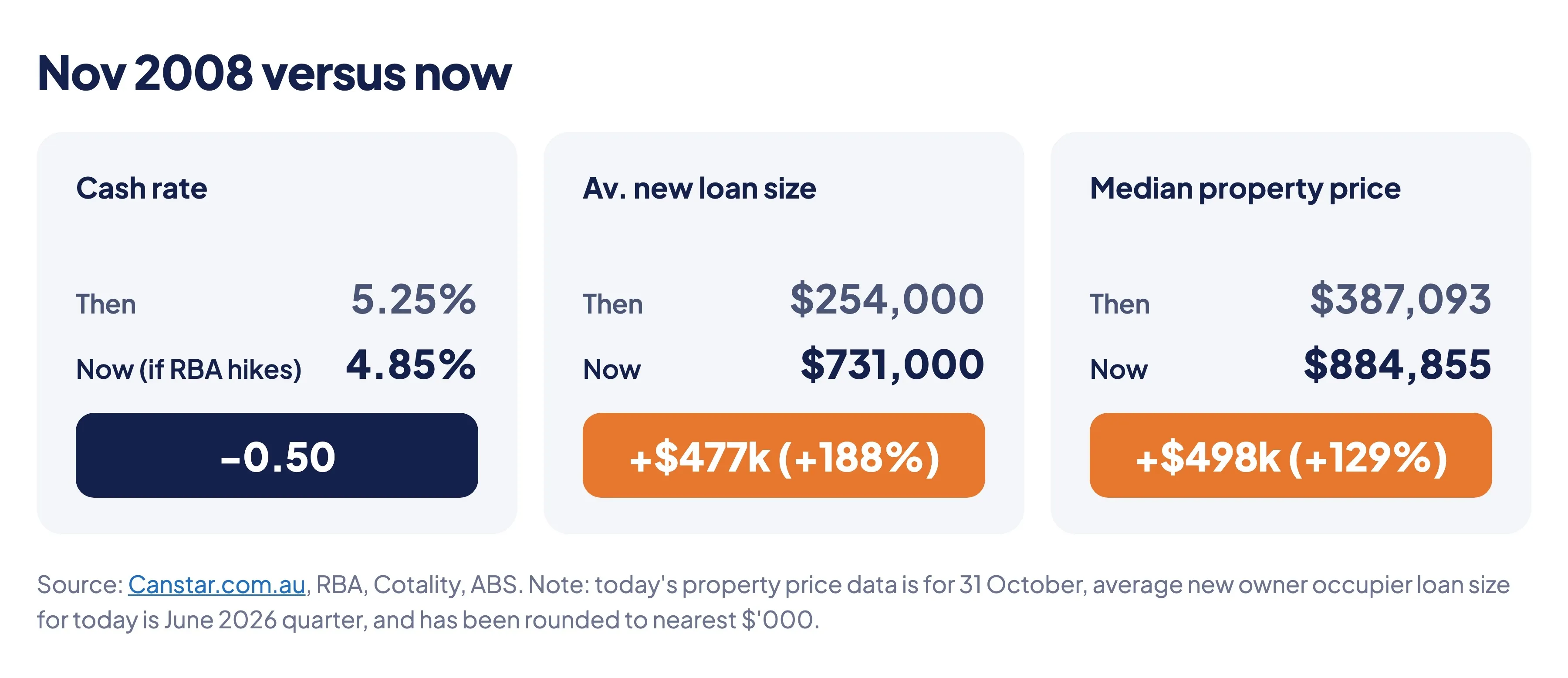
Source: Canstar.com.au. RBA, Cotality, ABS. Note: Today's property price data is for 31 October, average new owner occupier loan size for today is June 2026 quarter, and has been rounded to nearest $1000.
Average borrower faces an almost $500 repayment hike in 2026
A 0.25 percentage point increase tomorrow would add $92 to the monthly repayments for a borrower with a $600,000 loan and 25 years remaining, according to Canstar.
This would take the cumulative increase across the five hikes since February to $456 a month for this borrower.
Impact of 0.25 cash rate hike in November on monthly repayments | ||
Loan size at start of 2026 hikes | Hike in Nov | Cumulative increase across 5 hikes |
$500,000 | +$77 | +$380 |
$600,000 | +$92 | +$456 |
$700,000 | +$107 | +$532 |
$800,000 | +$123 | +$607 |
$900,000 | +$138 | +$683 |
$1 million | +$153 | +$759 |
Source: Canstar.com.au. Based on an owner-occupier, principal & interest loan with 25 years in Feb 2026 at the RBA avg var rate. Assumes banks pass it on the month after. Changes are to min repayments.
Who will struggle with a fifth rate hike?
It’s a tale of two cities when it comes to borrowers, with APRA data showing money in offset accounts are at near record highs at $340.5 billion.
Westpac is the latest big four bank to publish its full-year results, reporting today 14% of its mortgage customers have no buffer in their loan.
Big four bank customers’ home loan repayment buffers | ||
Accounts ahead on repayments | Accounts with no buffer | |
85% | 15% | |
86% | 14% | |
86% | 14% | |
88% | 12% | |
Source: CBA FY26 results, Westpac FY26 results, NAB & ANZ half year results. Extra repayments include offset balances.
What will a good rate look like after a 0.25 hike?
If the RBA hikes by 0.25 percentage points tomorrow, and banks pass it on in full, as they are expected to do, it will push the average owner-occupier variable rate to 6.74%.
While rates under 6% will disappear, Canstar expects the lowest rates to remain under 6.20%, while competitive rates will still be on offer up to 6.50%.
Estimated variable rates if the cash rate rises to 4.85% | ||
Owner-occupier | Investor | |
Average | 6.74% | 6.97% |
Competitive | < 6.50% | < 6.70% |
Lowest | 6.14% | 6.19% |
Source: Canstar.com.au. Rates are estimates of Canstar and RBA data.
Repayment resilience check
For households, the real test is whether their budgets can withstand another increase without sacrificing essential spending, draining savings or relying on credit.
How to check your repayment resilience:
- Earmark the extra cash: check what your new repayment would look like after another increase and identify where the extra money will come from.
- Know your breaking point: understand at what rate your budget might hit breaking point. This way, you’ll know when to really hit the alarm.
- Check up on your emergency fund: work out how long your savings would cover essential expenses if your household income changed unexpectedly.
- Make breathing room: Find instances in your budget where you can cut back, suspend or delay financial commitments if needed.
If, in this process, you discover your budget is on the ropes, call for help and start with the National Debt Helpline on 1800 007 007.
Canstar.com.au’s data insights director, Sally Tindall, says, “The pressure is really starting to mount and it’s not just on our central bank.”
“Borrowers are already under extreme financial pressure after four rate hikes this year. If the RBA ratchets up the cash rate once again, some will hit their financial ceiling.
“While interest rates could be returning to levels last seen almost two decades ago, today’s borrowers are carrying significantly more debt, making every 0.25 percentage point increase that much more painful.
“For someone with a $600,000 mortgage, another rate hike will mean finding an extra $92 a month to clear their new minimum repayments. However, across what would be five hikes for the year, the total increase would be a jaw-dropping $456.
“That’s almost half a grand in post-tax dollars a fairly typical borrower would have to find, every single month for the foreseeable future.
“The question now is how much more room households have in their finances. Some borrowers will be able to absorb another increase within their current budget, but others may be forced to raid their savings – a finite resource that in a perfect world remains untouched.
“The biggest concern is those with no buffer to fall back on.
“Borrowers should stress-test their finances to understand their rate resilience. Work out what another rate rise would mean for your repayments, take stock of your savings buffer and identify where you could free up cash if needed.”
Compare products, monitor your credit score, track interest rate changes, and access the deals, download the Canstar app: www.canstar.com.au/app.
