






The Commonwealth Bank has announced changes to its rewards credit cards to come into effect on 29 September, two days before the RBA’s surcharge ban kicks in.
The details, which are being sent to CBA credit cardholders today, present a major overhaul to the rewards program but also complementary insurances and card fees.
It follows on from the bank’s announced overhaul to its perks program.
Big bank competitor, Westpac, on Monday, released upcoming changes to its rewards credit card program, due to take effect on 30 September, ahead of the RBA surcharge ban (see details below).
NAB announced its changes at the end of last month.
ANZ is yet to outline ongoing rewards changes, however, it has scaled back its sign-up points offering.
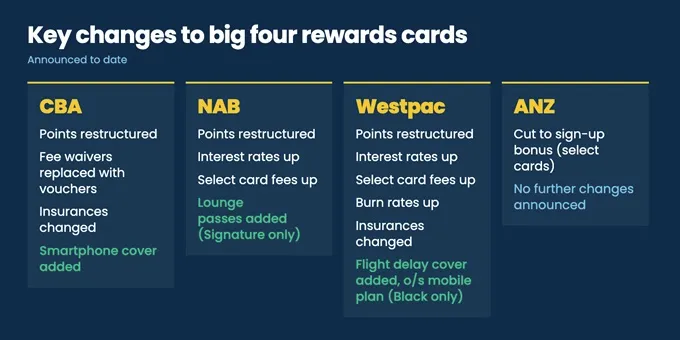
Note: For full details on changes, check providers’ sites.
CBA rewards credit card changes – in detail
CBA credit card customers with Awards points will automatically have their points transferred to the Yello program from 29 September, provided they are eligible. This requires them to hold a CBA transaction account and make at least five purchases a month on that account.
The earn rate for credit card holders will be based on how many products they have with CBA.
The bank is also changing select burn rates on its rewards program, including to redeem gift cards via Myer.
Example of changes to the number of points required to redeem rewards: CBA | |||
| Pts required before 29 Sept | Pts required after 29 Sept | Change |
$50 Myer Gift Card | 10,950 | 12,500 | +14% |
Source: CBA. Note: Points amounts are estimates.
Customers who are not eligible for the Yello program can get their points converted to cash up until 31 December, however, they will need to contact the bank to do so.
End of a Qantas Frequent Flyer era
CBA’s move from its Awards program to Yello downgrades the bank’s partnership with Qantas’ Frequent Flyer program.
Credit card customers who are opted into the Qantas Frequent Flyer program will have their outstanding Awards points transferred to Qantas automatically. The Qantas Frequent Flyer annual fee will be repaid on a pro-rata basis.
From 1 October, Qantas Frequent Flyer points will no longer be available on the Smart card but will continue to be available on the Ultimate card.
CBA credit card changes: 29 September 2026 | |
Card | Key changes |
Ultimate credit card |
|
Smart credit card |
|
Awards credit card |
|
Low rate + Low fee cards |
|
Source: Canstar. Note: Monthly fee waiver changes to begin from 1 Jan 2027. Diamond Awards, Platinum Awards and Gold Awards have not been available for sale for some time, but existing cardholders will also see changes.
Westpac rewards credit card changes – in detail
Westpac has this week announced major changes to its rewards credit card offering including interest rate hikes, card fee increases and a recalibration of earn rates (that is, the amount of points you earn per dollar spent).
The bank is also increasing the burn rates on its rewards program, that is, the amount of points required to redeem a reward, effectively reducing the value of points when redeeming certain options.
Examples of changes to the number of points required to redeem rewards: Westpac | |||
| Pts required before 30 Sept | Pts required after 30 Sept | Change |
$100 eGift Card | 23,500 | 29,412 | +25% |
$100 cashback | 28,200 | 31,250 | +11% |
$100 annual fee rebate | 20,000 | 26,316 | +32% |
Source: Westpac. Note: points amounts are estimates.
These changes are in addition to scaling back of the bank’s credit card insurance offering on 1 October, including the scrapping of trip cancellation, travel delay, vehicle excess, accidental death and luggage cover for international travel insurance, announced last month.
Westpac credit card changes: 30 September 2026 | |
Card | Key changes |
Altitude Rewards Platinum |
|
Altitude Rewards Black |
|
Altitude Qantas Platinum |
|
Altitude Qantas Black |
|
Altitude Velocity Platinum |
|
Altitude Velocity Black |
|
Source: Canstar. Notes: Minimum payment amount on the above cards is increasing from 2% or $10 (whichever is higher) to 2.5% or $25.
What should credit card customers do?
Watch your inbox for notice of variation emails from your card provider and be on the lookout for three key things:
- A drop in rewards perks: That could be a downgrading of your ‘free’ insurances or no more lounge passes.
- A points squeeze: Your card provider might reduce your earn rate, that is, the amount of points you earn per dollar spent, or hike your burn rate, which is how many points you need to redeem a reward such as a gift card.
- Price hikes: That could be an increase in your interest rate, annual fee or currency conversion fees for international purchases.
If you do get a note from your bank telling you the value of your rewards points is about to take a nosedive, do a check to see if you are still getting bang for buck from your card.
The rewards credit card health check
- Step 1: Write down how much you paid in fees over the last year.
- Step 2: Check how much interest you’ve been charged in this time.
- Step 3: Log on to your rewards program and calculate the value of points redeemed (rather than collected) in the past 12 months.
- Step 4: Do the equation: the value of points redeemed must be greater than the interest charges + fees paid. Otherwise, your card is getting the better of you.
Canstar data insights director, Sally Tindall, says, “The dominoes are falling quickly across the credit card sector with CBA the latest bank to announce a shake up of its rewards offering ahead of the RBA’s card surcharge ban.”
“The Reserve Bank’s upcoming cap on interchange fees will see these charges reduced by up to 63 per cent for credit cards and it’s clear banks aren’t willing to absorb this loss.
“As a result, banks are reducing the value of many of their rewards card programs through a combination of higher fees, higher interest rates, lower insurance cover and changes to how points are earned.
“Westpac is taking the squeeze even further by hiking its ‘burn rates’ – that is, the amount of points a customer has to shell out for a particular reward.
“For example, when the changes kick in, Westpac customers will need to use an estimated 25 per cent more points to redeem a $100 eGift card.
“The Commonwealth Bank’s points shake up includes a strategic tethering of credit card earn rates based on how many other CBA banking products a customer has, shifting from a standard reward structure to a retention model.
“Customers who hold multiple banking products with CBA can still earn up to 1.5 points per dollar spent, however, those who don’t use a CBA transaction account regularly, could end up earning no points at all.
“The big question for customers is whether they’re going to come out ahead after the RBA surcharge overhaul.
“If your bank is changing your card, don’t just look at how many points you’ll earn. Check the annual fee, interest rate, insurance cover and compare the total package with what you could get elsewhere.
“If the value of the rewards and perks doesn’t comfortably outweigh the fees and other costs, it may be time to break up with your rewards card.”