



.webp?w=2048)







Average electricity bill in Australia
The table below shows the average electricity bill by state across Australia based on Canstar's latest Pulse survey.
State | Average quarterly |
Queensland | $518 |
Victoria | $470 |
Australian Capital Territory | $433 |
New South Wales | $497 |
South Australia | $477 |
Tasmania | $584 |
Source: Canstar Pulse Survey, May 2026
Households in the Australian Capital Territory and South Australia reported the lowest average electricity bills.
On the other hand, households in Tasmania, Queensland and New South Wales reported the highest quarterly average electricity bills.
Average electricity bill based on household size
The following table shows the average electricity bill by household size across Australia, according to Canstar’s research.
Household size | Average annual electricity bill ($) |
1 person | $1,252 |
2 people | $1,548 |
3 people | $1,910 |
4 people | $2,015 |
5 people | $2,127 |
5+ people | $2,447 |
Source: Canstar Pulse survey, May 2026. Average electricity bill based on household size (n=4,205).
Average electricity bill based on age group
You’ve now seen the average costs by state, capital city and household size – but how does your age impact what you’re charged for electricity? Canstar collated recent Pulse survey data to show the average electricity bills by age group at a national level.
Average electricity bill based on age group | |
Age group | Average annual electricity bill ($) |
18-24 years | $1,782 |
25-34 years | $1,853 |
35-44 years | $1,846 |
45-54 years | $1.782 |
55-64 years | $1,600 |
65-74 years | $1,377 |
75+ years | $1,300 |
Source: Canstar Pulse Survey, May 2026.
Pensioners and seniors typically pay less for power on average for these reasons:
- Some electricity retailers offer extra discounts for senior cardholders and pensioners.
- Seniors may be eligible for government rebates on their electricity bills, potentially reducing their fees below the average electricity bill for a twoor one-person household.
- Younger people may live in larger households with high electricity usage needs, while older energy customers are more likely to have a solar system installed.
- Younger Australians are more likely to live in rentals, which may limit their access to energy-efficient technologies or upgrades.
Could I pay less than the average electricity bill?
Yes, you could absolutely pay less than the average electricity bill in your state. The easiest way to start saving is by switching to a cheaper energy plan.
For example, this table shows some of our database’s cheapest electricity plans, based on a general usage assumption in a selected postcode for each capital city.
Capital city | Cheapest electricity plan (yearly costs) |
Sydney | $1,321 |
Melbourne | $1,123 |
Brisbane | $1,410 |
Adelaide | $1,805 |
Canberra | $2,032 |
Hobart | $1,229 |
Source: www.canstar.com.au - 4/09/2026. Based on single rate electricity plans on Canstar's database; excluding solar-only plans. One product shown per distribution network. Annual costs calculated based on the estimated lowest possible price a representative customer would be charged in a year, assuming all conditions of discount offered (if any) have been met. Representative customer based on the 2025 reference usage for NSW, VIC, QLD, ACT, and SA (per Victorian default offer for VIC, ICRC for ACT, and AER for others) or the median usage in the Office of the Tasmania Regulator's report, Typical Electricity Customers in Tasmania 2025 for TAS.
Keep in mind that costs can vary significantly between suburbs and household sizes, and that your actual usage may differ from general estimates. But this provides a helpful guide as to how much you could be saving.
What impacts electricity bills?
Electricity usage
How much your bill costs increases with how much electricity you’re using. The more energy you consume, the larger the bill. How much electricity is used is affected by the following:
- Size of the household: Small households of two or three people will typically use less energy than a larger household of four or five people.
- Your appliances: Not all appliances are made equal, with some being more energy-intensive than others (e.g. air conditioners and clothes dryers).
- The appliances you run: How often you use your appliances, leave them switched on or on standby influences your electricity usage.
- Season and climate: Colder seasons or climates could influence how often you take hot showers or dial up indoor heating. Conversely, summer seasons or warmer climates could see an uptick in your air-conditioning use.
- If you have solar panels: You could use your solar panel’s generated energy for export to the grid in exchange for a bill credit (if you’re on a solar feed-in tariff plan), supplement your household electricity use, or store it for later use (if you have a solar battery).
Electricity prices
The other major factor in determining energy costs is the price you pay for electricity.
On every bill, Aussies should expect to pay two charges — supply and usage charges:
- Supply charges: Supply charges are a fixed daily charge (in cents) that households must pay to remain connected to the electricity grid.
- Usage charges: Usage charges are variable charges (in c/kWh) that households must pay for every kWh of electricity consumed.
However, usage charges can vary significantly based on the type of tariff you’re on, which refers to how you’re billed for your energy usage:
- Single rate tariff: Customers on a single rate tariff pay a flat rate for every unit of electricity, no matter the time it was consumed.
- Time of use tariff: Customers on a time of use tariff pay higher usage charges during peak hours and lower usage charges during off-peak hours. Shoulder rates, which sit between peak and off-peak hours, are priced somewhere in the middle.
- Controlled load tariff: This is a tariff exclusively for high-consumption appliances, which are metered at a lower rate and separately from the rest of your home.
- Demand tariff: Supply and usage charges with an additional 'demand charge'. The demand charge is set based on your maximum energy use at a specified time.
Type of electricity plan
In an energy deregulated state, there are two types of electricity plans — standing offers and market offers.
- Standing offers (comparison price): Government-regulated, basic plans that are used as a benchmark for retailers to set their own plans, and for consumers to compare other electricity plans against (price differences are expressed as a %). They typically represent the highest price most retailers are willing to charge.
- Market offers: Plans freely set by retailers to have competitive rates and attractive discounts. Some market offers have variable rates, meaning rates can change their rates before the offers expire, while others have fixed rates, where rates stay the same throughout the contract term.
While some market offers are priced higher than a state’s standing offer, they are typically cheaper. That’s because they usually:
- Have lower usage and supply rates
- Have discounts such as sign-up credit, but it’s not an automatic guarantee that you’re saving the most money on that plan.
Just remember: not all market offers last forever. If your market offer expires, your retailer may roll you over onto their standing offer. In this situation, you’re likely paying the most a retailer will charge you.
It may be wise to set a calendar reminder to compare energy plans a few weeks before your plan expires.
How else can I tell if I pay the average electricity bill in Australia?
Most electricity providers publish helpful information in their bill statements, such as
- The actual amount of energy (in kilowatt-hours) used and what it costs.
- How your usage has changed over time.
- How your usage compares to other customers in your area
The following image is taken from an Alinta Energy bill, showing the customer’s electricity usage compared to that of other households.
For more information on your electricity bills, visit the Canstar guide on how to read your electricity bill.
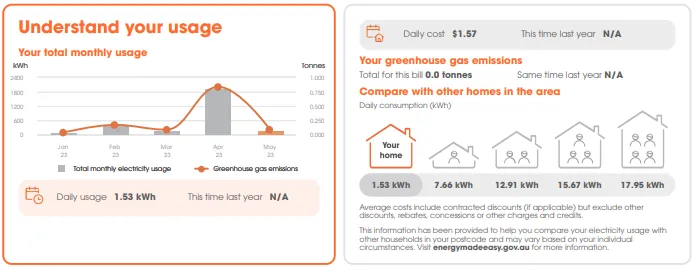
Alternatively, you can also assess your real-time or historical usage by installing a power usage monitor or through your provider's dedicated smartphone app (assuming you already have a smart meter installed).
Other useful information found on your electricity bill includes:
- The name of your electricity plan, which can help you verify if you’ve been moved onto a standing offer.
- Best offer messaging, which gives you a dollar figure for how much you could save by switching to your retailer’s cheapest plan.
Start comparing energy plans
The good news is that – unless you are already on the best deal in your area – there are potentially big savings to be had by shopping around.
Whether you’re comparing your expenses to the average electricity bill or aiming to pay lower than the average electricity bill for a two-person household, proactive research and switching to a better plan will help you save money.
To start with, click on the ‘Get Started’ button at the top of the page (above the comparison table). You’ll then be asked a few qualifying questions, such as your postcode, before we take you to the results page.
Here, you’ll be shown the cheapest energy plans on our database that are available at your postcode.
You can filter the results to further narrow your search:
- Single rate, ToU or controlled load tariffs (for electricity only)
- Monthly, quarterly, or yearly estimated cost
- Deals, discounts and offers.
You can also sort the results based on the following presets:
- Estimated price (ascending or descending)
- Provider names alphabetically (ascending or descending)
- Feature rating (from highest stars to lowest stars, or vice versa)
- Solar FiT for electricity only (from highest to lowest, or vice versa)
- Comparison price for electricity only (from highest to lowest, or vice versa).

.webp?w=640)
![Electricity price changes in Australia [July 2026]](https://cns-payload-prod-01-content.global.ssl.fastly.net/payload-media/169%20Ratio%20Images%20(640px%20x%20360%20px)%20(1).webp?w=640)