
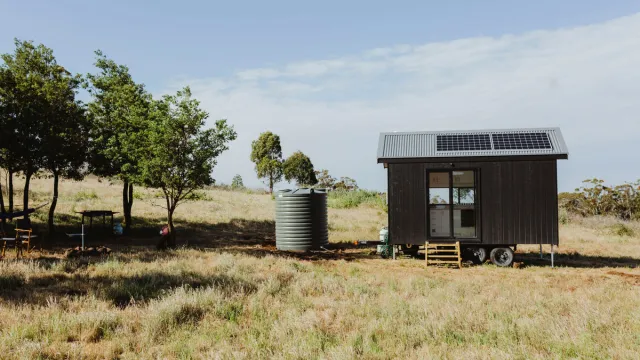
The dream of a quarter-acre block, five bedrooms, and a pool is out (of my budget, at least). You know what’s in? Tiny homes.
And don’t be fooled. A tiny house doesn’t equal a tiny life. Take it from me, an avid small-space-sympathiser, small living can pay large dividends. After all, fewer square metres to vacuum, limited cupboards to cram with stuff, and power bills that don't make you weep are luxuries in themselves. So, how much will such luxury set you back?
What is a tiny house?
According to the Australian Tiny House Association, a tiny house is a moveable dwelling of up to 50 square metres in size, suitable for permanent residential use. It has self-contained services and amenities and the option to be connected to the grid.
A tiny house can fall into one of several categories:
- A tiny house ‘on skids’ is a structure that has the ability to be moved
- A tiny house ‘on wheels’ is constructed on a trailer
- Tiny houses can also be constructed out of shipping containers
A tiny house is considered to be a different category to a ‘granny flat’, which typically refers to a fixed structure built on the same piece of land as an existing house.
How much does a tiny house cost?
The cost of a tiny house will vary, depending on how big you need it to be, the materials you use, and whether you buy a pre-fabricated kit home or employ a tradie to build it from scratch.
Various tiny home builders and pre-fab construction companies offer insights into how you might expect a tiny home to cost, with prices typically starting at around $60,000 and rising to more than $200,000, depending on factors like the quality and size of the project.
If you opt for the DIY approach, a tiny home could cost even less. Tiny home ‘kits’ and ‘pods’ are available from major retailers for around $15,000 to $30,000, depending on the size.
Though, entry-level pods are often empty shells, meaning you’ll need to budget for internal fit-outs, foundations, utility connections, and council permits.
Don’t forget tiny home delivery costs!
Remember, depending on how you choose to receive your tiny home (fully assembled, in pieces, or as a flat pack), you might face hefty delivery fees. This could particularly be the case if you live in a regional or remote area.
Can you DIY a tiny house?
Depending on your needs, budget, and skill level, you might choose to buy a kit containing the materials to build your own tiny house, which leaves the assembly to you.
You may then choose to build the house yourself or pay a builder to do it.
Whatever your approach, you’ll need to make sure your tiny house complies with the relevant building and safety standards in your area, or road safety vehicle standards if it's on wheels.
If you're even more handy, you could opt to build a tiny home from scratch. Just be sure to get professional advice on the plans and permits you need to ensure full compliance. And call in tradies when you need them, as it's illegal to DIY things like plumbing or electrical work.
What other tiny house costs will you need to consider?
In addition to the cost of purchasing a tiny house, there will also be costs associated with keeping it running and powered, especially if you plan on living off grid. Some important extra costs to consider include:
- Electricity (solar power systems)
- Generators
- Composting toilets
- Water tanks
- Grey water systems
- Grease trap systems
If you plan to live off the grid in a tiny house, it’s important to think about your energy consumption habits. High energy-consumption appliances like air conditioning systems, electric kettles and toasters, cooktops and ovens may need to be used sparingly or substituted for energy-efficient alternatives.
Can you get a home loan for a tiny house?
Given that tiny houses tend to be portable, you may find that obtaining a traditional home loan for one is not possible. Still, there are other other finance options on the table:
- Using equity from your land: If you already own the land you plan to put your tiny house on, you could access equity from it, or from an existing property you own, to finance the purchase.
- Taking out a personal loan: You may apply for a personal loan to finance the purchase of a tiny house. It’s important to be aware that personal loan terms tend to be shorter than home loan terms – typically up to seven years – and interest rates tend to be higher.
- Taking out a caravan loan: A caravan loan could be an option for finance if your tiny house is on wheels and meets all relevant regulatory and safety standards.
How do you insure a tiny house?
One important tiny house cost to consider is the cost of insurance.
As many Australian tiny houses are built on trailers and are subsequently classified as caravans rather than houses, you may have to take out caravan insurance in order to insure your tiny house and its contents.
Though, depending on how it’s built, your tiny home might not make the cut for caravan insurance.
If your tiny house is permanently fixed to foundations or skids, you may be able to take out a regular home building and contents insurance policy. Though, insurers may require compliance documentation and certificates from registered tradies, even if you built the tiny home yourself.
If you’re unsure, or you’d simply like an expert’s advice, you can reach out to Canstar’s home insurance broker service for support.
What are the pros and cons of tiny house living?
Potential pros of living in a tiny house
- Sustainability: If you choose to install solar panels and a water tank as part of your tiny house, you may end up living in a self-sufficient home. The construction of a tiny house may also generate a smaller carbon footprint than the construction of a traditional home, due to its smaller size.
- Mobility: If you enjoy going on road trips or camping holidays, a tiny house on a trailer could be taken with you. However, you may need a 4WD or similarly large vehicle in order to tow something as heavy as a tiny house.
- Lower overhead costs: If your tiny house generates most or all of its own electricity and water, your utility bills could be considerably smaller than if you lived in a traditional home.
- Less cleaning up: A smaller home means less space, which in turn means that doing even the most thorough house clean will generally take considerably less time than cleaning a conventional house.
Potential cons of living in a tiny house
- Small size: As the name suggests, tiny houses have smaller floor plans and less living space than full-sized homes, so you will need to be prepared to live in a more intimate space, and potentially be prepared for a Marie Kondo-style cull of your belongings.
- Difficulty finding a location: Unless you have a friend or family member with a backyard that they’re happy to let you use, you’ll need to either buy or rent land to park your tiny house on. This can make what was supposedly a cheap option significantly more expensive.
- Potential for red tape: While being classed as caravans allows some tiny houses to avoid regulatory red tape, you may still encounter issues depending on where you live. Local councils may have their own specific rules and regulations regarding tiny houses. Do your research or seek legal advice before committing.
- Self-sustainability: Whilst the potential for sustainability may be appealing, you’ll need to make sure to secure your electricity and water supply and have a backup plan in place in case you run out.
- Fewer creature comforts: Living in a smaller house means less space. Things like clothes driers, spacious fridges, and even a standard washing machine may prove impractical depending on the size of your tiny house.
- Potential for clutter: Whilst living in a smaller space can make tidying up a breeze, it also makes dirtying or cluttering your home easier too. A mess that might’ve seemed proportionately minor in a conventional home could be a bit more significant in a tiny house.