






NAB is the latest big bank to change its cash rate forecast, with a hike now expected in just under five weeks’ time following the RBA’s next Board meeting on 28 and 29 September.
NAB has also flagged another hike may be required in November, although this is not the bank’s base case. If this happened, it would take the country’s cash rate to 4.85%, the highest setting since the GFC (November 2008).
The bank’s change in forecast comes following yesterday's unsettling inflation figures. Fellow big four banks CBA and ANZ also now predict the RBA will hike, albeit in November.
Westpac has not made any changes to its forecast.
Big banks updated cash rate forecasts | ||
|---|---|---|
Next move | When | |
CBA | HIKE | +0.25 in Nov 2026 |
Westpac | CUT | -0.25 in Aug 2027 |
NAB | HIKE | +0.25 in Sep 2026 |
ANZ | HIKE | +0.25 in Nov 2026 |
Source: Prepared by Canstar.
How much would two more rate hikes cost borrowers?
A 0.25 percentage point rate hike in September would add approximately $91 to the monthly repayment on a $600,000 loan with 25 years remaining, according to analysis by Canstar.
A further rate hike in November would add another $92 to these repayments. Across what would then be five rate hikes this year, the total increase to monthly repayments would be $456.
Impact of further 0.25 hike | |||
|---|---|---|---|
Loan size at | Hike in Sep | Hike in | Cumulative increase |
$600,000 | +$91 | $91 + $92 | +$456 |
$800,000 | +$122 | $122 + $123 | +$607 |
$1 million | +$152 | $152 + $153 | +$759 |
Source: Canstar. Notes: based on an owner-occupier paying principal and interest with 25 years remaining in Feb 2026 at the RBA avg variable rate. Assumes rate hikes are in Sep + Nov and banks pass it on the month after. Changes are to minimum repayments.
Borrowers should find rate relief ahead of September meeting
The RBA might be poised for another hike, however, lenders are doing the exact opposite.
Rate tracking data from Canstar reveals that 35 lenders have lowered variable rates for new customers since June 1, including refinancers.
This wave of competitive repricing has expanded the sub-6% home lending club significantly. Today, 52 lenders offer at least one variable loan below this mark, with 14 lenders joining these ranks in the last three months.
While one big four bank, Westpac, is in this list, the lowest variable rates are from smaller banks and non-bank lenders, starting from 5.69%.
Lowest variable rates for refinancing | ||
|---|---|---|
Lender | Rate from | Min deposit |
Pacific Mortgage Group | 5.69% | 40% |
LCU | 5.79% | 5% |
The Mutual Bank | 5.79% | 20% |
Unity Bank | 5.80% | 5% |
P&N Bank | 5.83% | 20% |
Source: Canstar. Based on owner occupier loans, excludes construction, first home buyer only and green loans. Other eligibility conditions may apply.
Core inflation the window into the RBA’s woes
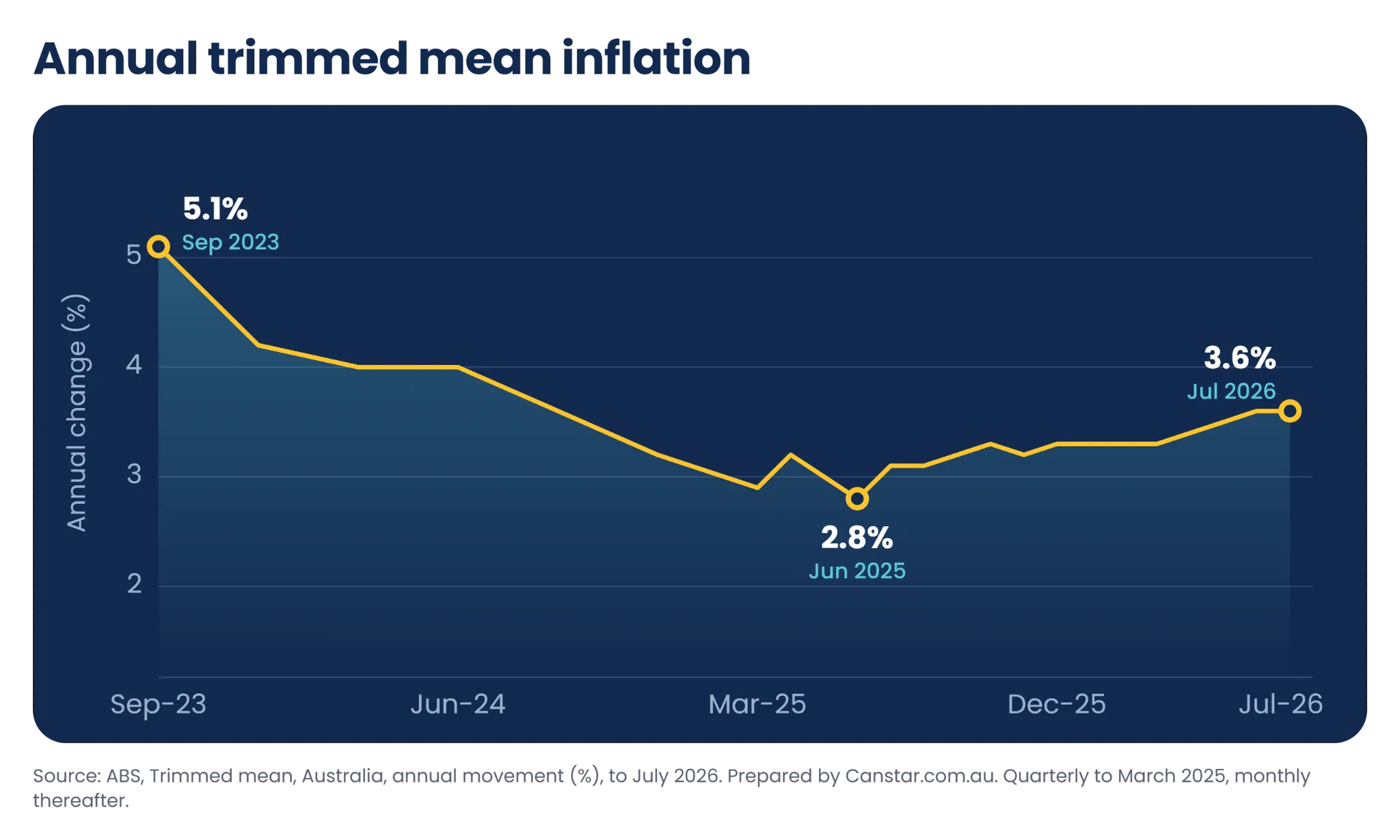
ABS figures released on Wednesday show headline inflation came in at 3.5% in the year to July, down from 3.8% the month prior. However, trimmed mean inflation, the RBA’s preferred measure, stayed put at an annual rate of 3.6%.
The last time core inflation went down was November 2025 – eight datasets ago. This is a troubling result for the RBA because it points to sticky price pressures that refuse to go away.
The release of the RBA Board minutes on Tuesday confirmed it won’t hesitate to pull the trigger on another hike if the risks keep mounting.
Canstar’s Data Insights Director, Sally Tindall, says, “Sticky core inflation is backing the RBA into a corner, with NAB the latest major to abandon hopes of a pause.”
“The bank’s economic team believes yesterday’s inflation results will push the RBA into hiking in just under five weeks' time, and potentially once more in November.
“Headline inflation might look like it's cooling on paper, but the central bank won't be swayed by window dressing. Trimmed mean inflation hasn't dropped since late last year, signaling that underlying price pressures remain entrenched in the economy.
“If we see back-to-back increases in September and November, as NAB has potentially flagged, borrowers with a $600,000 mortgage and 25 years remaining could be hit with an extra $183 a month in minimum repayments. Across the five hikes we’ve seen this year, that would add up to a staggering $456 monthly increase – a budget many households are not prepared for.
“Mortgage holders shouldn't wait for the Board's September decision to take action. If your variable rate starts with a '6' or a '7' as an owner-occupier, you are likely paying a loyalty tax that can be instantly shaved off by shopping around, or at least haggling with your current bank.”