





Australians have turned off their air conditioners and are washing clothes in cold water to cut electricity costs — but the majority are leaving the biggest savings on the table.
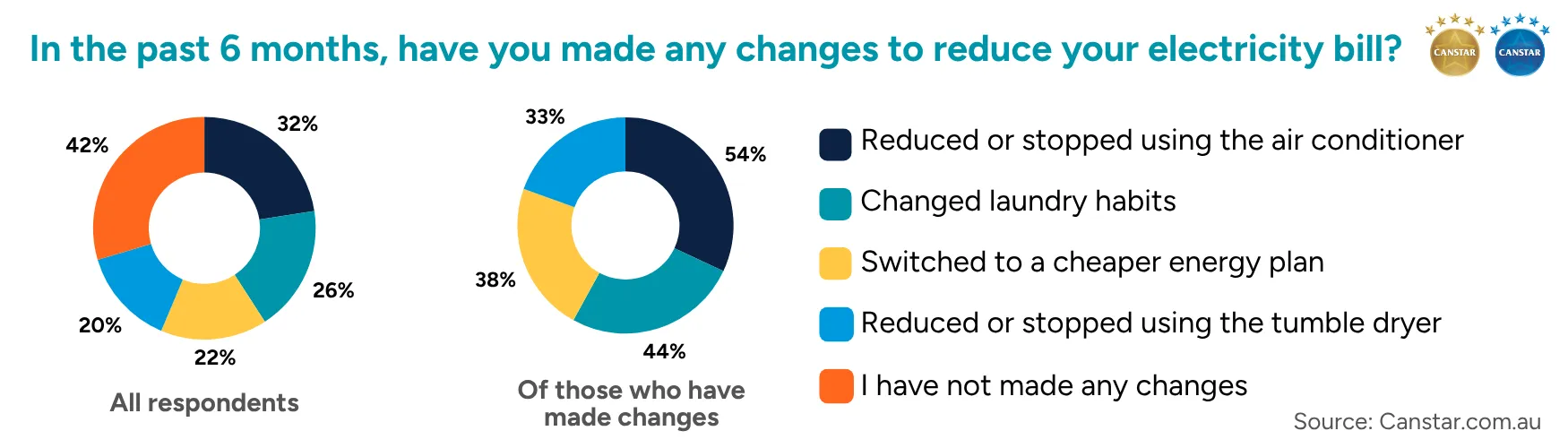
A new Canstar survey of more than 3,000 Australians reveals that over half have changed household habits in the past six months to reduce their bills, such as reducing/stopping the use of their air conditioners and tumble dryers or washing their laundry in cold water.
However, of those that had made changes, only 38% have done the one thing most likely to make the biggest dent: switching to a cheaper electricity plan. For many households, that single move could save more than $300 a year — no cold showers required.
Cutting down electricity use best done at the root
Making changes to energy use habits around the house can help reduce costs. Canstar modelling shows that for an average household of three in Sydney, doing cold laundry washes, reducing dryer use and cutting back each person’s shower time from nine to five minutes a day, could save $371 a year.
However, for maximum bill relief, also switching to a plan that offers cheaper rates would mean automatic savings every day.
If that same household were to switch from the average cost to the lowest cost electricity plan on the Canstar database, they could save $332 in the next year at an annual electricity use of 3,900 kWh.
Total potential savings | |
|---|---|
Action | Potential annual savings |
Switch to cold wash | $101 |
Cut down tumble dryer use from 3x to 1x a week | $107 |
Shorter showers: 9 min to 5 min | $163 |
Switch to lowest cost plan | $332 |
Source: Canstar See full methodology at end of release.
Small steps can make big impacts
Canstar's Data Insights Director, Sally Tindall, says, “It’s impressive to see just how front of mind energy consumption is among Australians. Canstar’s survey found 58 per cent of households are proactively trying to reduce their electricity costs.”
“Small steps such as using the dryer for emergency use only, shortening showers and washing in cold water unless you’re dealing with the mother of all stains can make an impact on your electricity bill.
“For a typical three person household in Sydney, these steps have the potential to knock the energy bill down by $371 a year.
“They're also good habits that can become second nature and get passed down the generations without even saying much more than a couple of words.
“Switching to a cheaper electricity plan can potentially offer similar or even bigger savings and give people the confidence to turn the heating on when the house is frosting over.
“Make lifelong changes within the home, but make one of them comparing your electricity plan at least once a year.”
Potential savings switching | |||
|---|---|---|---|
Average | Lowest | Savings | |
Sydney | $1,790 | $1,458 | $332 |
Melbourne | $1,444 | $1,155 | $289 |
Brisbane | $2,005 | $1,654 | $351 |
Adelaide | $2,179 | $1,805 | $374 |
Canberra | $2,418 | $2,032 | $386 |
Hobart | $1,343 | $1,229 | $114 |
Source: Canstar - 18/06/2026. Based on single rate electricity plans on Canstar's database; excluding solar-only plans. One product shown per distribution network. Annual costs calculated based on the estimated lowest possible price a representative customer would be charged in a year, assuming all conditions of discount offered (if any) have been met. Representative customer based on the reference usage for NSW, VIC, QLD, ACT, and SA (per Victorian default offer for VIC, ICRC for ACT, and AER for others) or the median usage in the Office of the Tasmania Regulator's report, Typical Electricity Customers in Tasmania 2025 for TAS.
Methodology and data
Average washing machine | ||
|---|---|---|
Wash Type | Usage kW) | Cost |
Cold | 133 | $44 |
Warm | 438 | $145 |
Difference | 305 | $101 |
Source: Canstar - 9/06/2026. Average energy consumption figures based on clothes washers listed in the Commonwealth of Australia E3 Program's Registration database, which assumes 7 uses per week using a warm wash. Electricity usage cost estimates based on the average electricity usage rate of 33.0 c/kWh. Average electricity usage rates are based on single-rate, non-solar only plans on Canstar's database, available for an annual usage of 4,373 kWh. Based only on washers that list both cold and warm wash usage. | ||
Average annual clothes dryers | ||
|---|---|---|
Loads Per Week | Usage (kW) | Cost |
1 | 161 | $53 |
3 | 484 | $160 |
Difference | 323 | $107 |
Source: Canstar - 9/06/2026. Average energy consumption figures based on clothes dryers listed in the Commonwealth of Australia E3 Program's Registration database. Electricity usage cost estimates based on the average electricity usage rate of 33.0 c/kWh. Average electricity usage rates are based on single-rate, non-solar only plans on Canstar's database, available for an annual usage of 4,373 kWh. | ||
Average shower annual | ||||
|---|---|---|---|---|
Gas | Water | |||
Usage (MJ) | Cost | Usage (L) | Cost | |
5 minutes | 4,619 | $185 | 18,250 | $68 |
9 minutes | 8,314 | $333 | 32,850 | $122 |
Difference | 3,695 | $148 | 14,600 | $54 |
Source: Canstar - 9/06/2026. Average energy consumption figures based on gas hot water heaters listed in the Commonwealth of Australia E3 Program's Registration database. Gas usage cost estimates based on the average gas usage rate of 4.0 c/MJ. Average gas usage rate based on summer rates of single-rate plans on Canstar's database, available for an annual usage of 33,625 MJ. Water usage cost estimates based on the average water usage rate of $3.71 / kL. Average water usage rate based on ABS Water Account statistics (2023-24). Assumes water consumption rate of 10L/min. | ||||