







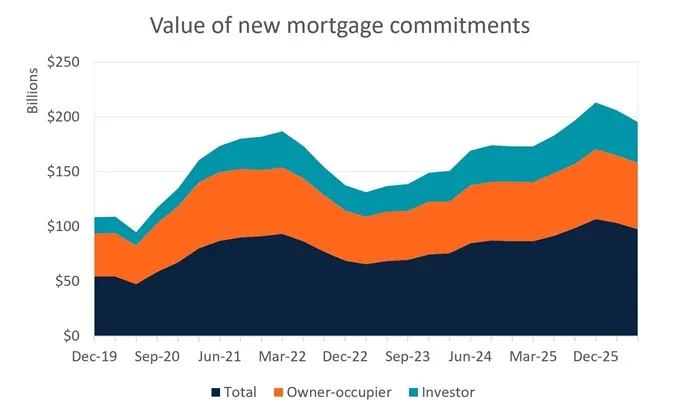
The value of new mortgages fell by a hefty $5.4 billion in the June quarter as buyers piled out of the market on the back of a third cash rate hike and the federal government’s property tax announcement.
ABS lending indicator data, released today, shows the total value of new housing loans settled in the June quarter was $97.6 billion, down $5.4 billion or 5% compared to the previous quarter, in seasonally adjusted terms.
This was the second consecutive drop in the value of new loan commitments and the first time lending has fallen for two quarters in a row in over three years.
Investors led the retreat, with the value of these new loans falling by $4.2 billion – a 10% drop from the March quarter and the biggest drop in dollar terms since 2015.
Owner-occupier lending recorded a more modest fall of $1.2 billion (-2%) compared to the previous quarter.
However, both owner-occupier and investor new lending in the June 2026 quarter was noticeably higher than the same period last year.
Value of new lending in June quarter 2026 | |||
|---|---|---|---|
Loan type | Value of loans | Quarterly change | Annual change |
All loans | $97.6 billion | -$5.4 billion -5% | +$6.2 billion +7% |
Owner-occupied | $60.5 billion | -$1.2 billion -2% | +$3.4 billion +6% |
Investment | $37.1 billion | -$4.2 billion -10% | +$2.8 billion +8% |
Source: ABS Lending Indicators June 2026, prepared by Canstar. Based on seasonally adjusted figures.
Source: ABS, seasonally adjusted data.
Big four bank reporting mirrors slide in new lending
Today’s ABS figures follow on the back of reported drops in new mortgage applications from Australia’s biggest banks:
- CBA this week reported a drop in new residential mortgage applications of 15% since 12 May.
- Westpac this week reported an average drop of 20% in mortgage applications between 15 May and 31 July compared to the previous quarter.
- NAB last month reported a drop of 15% in its home lending applications in the June quarter compared to the previous one.
Average new loan size falls in NSW, Victoria, Tas and ACT
The national average new owner-occupier loan size fell for the second consecutive quarter, albeit by a relatively minor $4,000 (-1%) in the June quarter, down to $731,000.
NSW continues to have the largest average new loan size in the country for owner-occupiers at $842,000, despite a $19,000 fall over the quarter. The drop in loan sizes suggests some buyers have hit their borrowing limits, with successive rate hikes slashing borrowing power.
Victoria’s average loan size also edged down to $664,000, while Tasmania and ACT also recorded drops during the quarter.
Queensland, South Australia, Western Australia and Northern Territory all recorded record-high average loan sizes this quarter.
All average new owner-occupier loan sizes are considerably up from the same quarter a year ago.
Average new owner-occupier loan size in June 2026 quarter | |||
|---|---|---|---|
Loan size | Quarterly change | Annual change | |
Australia | $731,000 | -$4,000 -1% | +$53,000 +8% |
NSW | $842,000 | -$19,000 -2% | +$27,000 +3% |
Vic | $664,000 | -$11,000 -2% | +$25,000 +4% |
Qld | $751,000 - record high | +$10,000 +1% | +$88,000 +13% |
SA | $672,000 - record high | +$7,000 +1% | +$74,000 +12% |
WA | $720,000 - record high | +$17,000 +2% | +$100,000 +16% |
Tas | $516,000 | -$5,000 -1% | +$33,000 +7% |
NT | $545,000 - record high | +$7,000 +1% | +$61,000 +13% |
ACT | $666,000 | -$1,000 -0.1% | +$31,000 +5% |
Source: ABS Lending Indicators June 2026, prepared by Canstar. Based on seasonally adjusted figures. Data is in original terms and rounded to the nearest $1,000.
First home buyer numbers return to normal
After surging back into the market in the December quarter, following the uncapping of the Home Guarantee scheme, first home buyer activity eased for the second time in a row, with the number of new first home buyer loans falling by 3% in the June quarter in seasonally adjusted terms. This was a drop of just 891 loans.
This takes it back to roughly the same level it was a year ago, with the value of new first home buyer loans up 0.05% annually.
Victoria saw the highest number of new first home buyers entering the market this quarter, with 9,407 new loans taken out, despite the small dip in numbers compared to the previous quarter. However, Northern Territory and South Australia recorded 28% and 20% increase respectively in the quarter.
First home buyer owner-occupier mortgages | |||
|---|---|---|---|
June 26 quarter | Quarterly change | Annual change | |
Value | $18.4 billion | +$46 million +0.25% | +$1.7 billion +10% |
Number | 29,319 | -891 -3% | +14 +0.05% |
Source: ABS Lending Indicators June 2026, prepared by Canstar. Based on seasonally adjusted figures.
Number of first home buyer loans by state | |||
|---|---|---|---|
June 26 quarter | Quarterly change | Annual change | |
Australia | 29,319 | -3% | +0.05% |
NSW | 6,937 | -7% | +2% |
Vic | 9,407 | -3% | -4% |
Qld | 5,646 | -1% | -2% |
SA | 2,181 | +20% | +23% |
WA | 3,554 | -5% | -2% |
Tas | 644 | +8% | +9% |
NT | 254 | +28% | -4% |
ACT | 865 | -9% | +5% |
Source: ABS Lending Indicators June 2026, prepared by Canstar. Based on seasonally adjusted figures.
Refinancing falls from record high
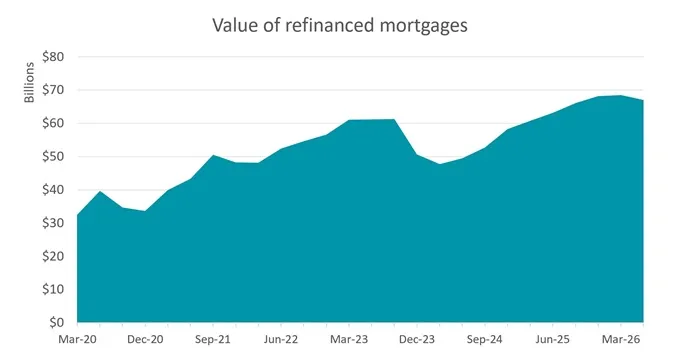
Switching activity eased in the June quarter, with the total value of loans refinanced falling 2% to $67.1 billion in seasonally adjusted terms, coming off the back of a record high in the March quarter.
Today’s figures show refinancing remains elevated at the third-highest level on record in dollar terms, on the back of three RBA rate hikes and a ramping up of the mortgage wars.
Total number and value of externally refinanced mortgages | |||
|---|---|---|---|
June 26 quarter | Quarterly change | Annual change | |
Value | $67.1 billion | -2% | +6% |
Number | 103,046 | -1% | +1% |
Source: ABS Lending Indicators June 2026, prepared by Canstar. Based on seasonally adjusted figures.
Canstar data insights director, Sally Tindall, says, “The housing market has hit the brakes, with a $5.4 billion drop in new lending compared to the previous quarter.”
“Investors led the retreat, with the value of these loans dropping $4.2 billion or 10 per cent, after three interest rate hikes and the federal government’s property tax changes have taken plenty of shine off the property market.
“Buyers across the country are feeling the pressure from both higher borrowing costs and reduced budgets, with many opting to sit on the sidelines to see where the chips land and at what price.
“The fall in the average new loan size in NSW is little surprise as maxed out buyers hit their limits in terms of borrowing capacity. The downturn in buyer sentiment is also likely to be playing a part, with less competition in near-empty auction rooms pushing prices down rather than up.
“In Victoria and the ACT, similar trends are occurring as the drop in new owner-occupier loan sizes mirror the falls in property prices.
“While Queensland, Western Australia and South Australia are still at record highs in terms of their average new owner-occupier loan sizes, we could well see drops through to the end of the year, with prices now starting to wobble in these states’ capital cities.
“The value of refinanced loans clocked in at the third highest level in the ABS records as borrowers seek out relief from rising rates. It comes as the mortgage wars between banks ramp up, with lenders looking to existing borrowers to make up for the shortfall in new loan applications coming through.
“This competition is worth taking advantage of. Anyone taking out a new mortgage or refinancing should be shopping around, because even a relatively small drop in interest rates can make a meaningful dent in repayments, particularly for those lugging around a giant wad of debt.”