







A fifth cash rate hike could see a person’s maximum home buying budget drop by 11% if the RBA hikes on Tuesday.
Canstar analysis shows someone earning the average full-time wage of $108,650 could see their borrowing power fall by a further $10,700 if the RBA delivers another 0.25 percentage point hike next week.
This would bring the total reduction in the maximum amount they can borrow from the bank to an estimated $58,100 since the start of 2026.
For a couple both earning the average full-time wage, another rate hike could strip a further $21,500 from their borrowing power. In total, five rate hikes could wipe $116,200 off this couple’s borrowing capacity since the start of the year.
Estimated change in borrowing capacity if the RBA hikes in November | ||
|---|---|---|
Borrower | Hike in Nov | Total drop since start of 2026 |
Individual (av. wage) | -$10,700 | -$58,100 (-11%) |
Couple (2 x av. wage) | -$21,500 | -$116,200 (-11%) |
Source: Canstar. Calculations are estimates based on an owner-occupier taking out a 30-year loan at the av. rate. Assumes minimal expenses, no debts, no dependents, av wage based on ABS data. Full notes below. These estimates are based on owner-occupiers taking out a 30-year home loan, with no other debts, no dependents and minimal expenses. Borrowing capacity estimates can vary between lenders.
Mortgage market remains subdued as rate hikes and tax changes take their toll
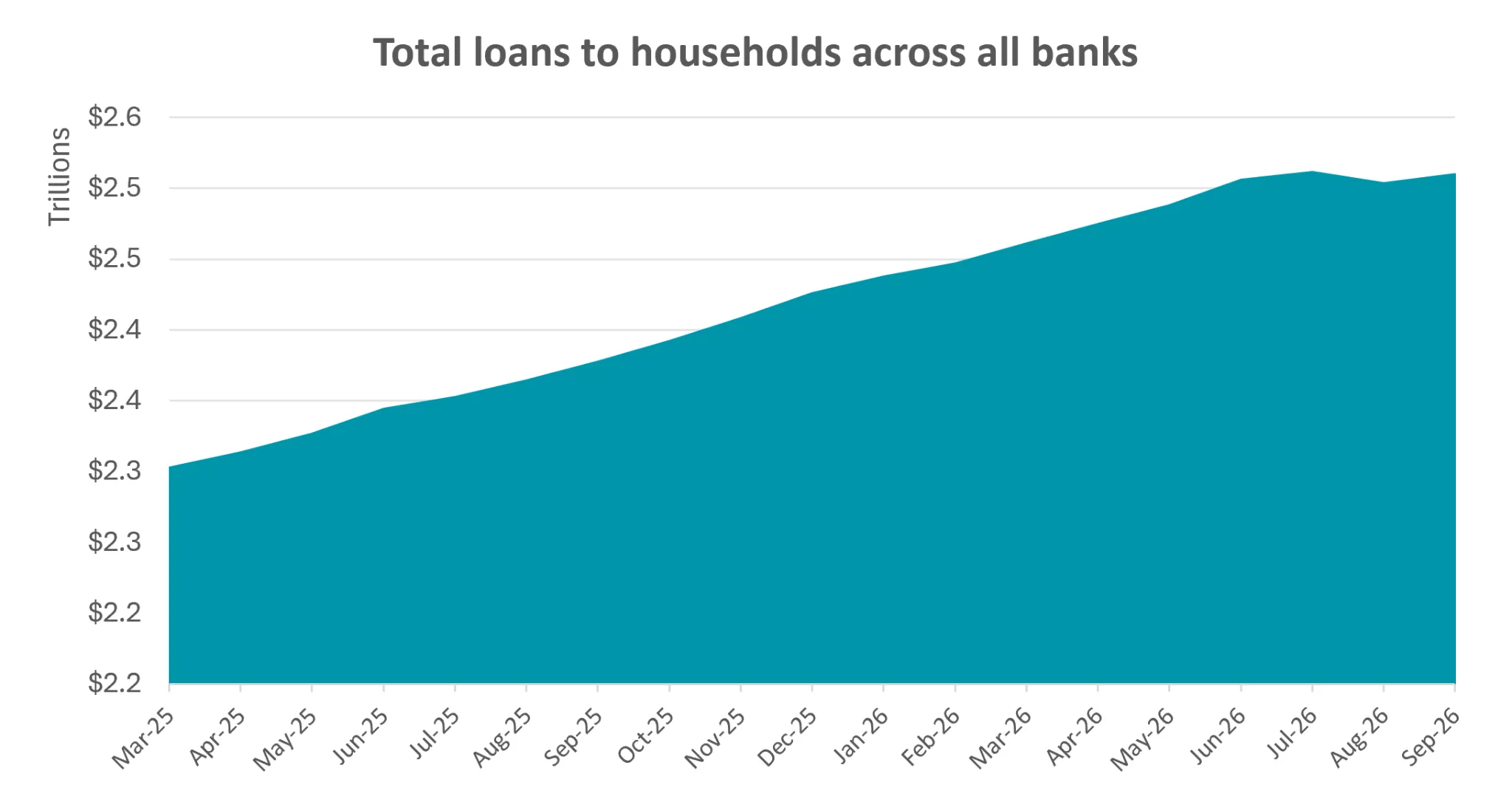
Four cash rate hikes have already had a noticeable impact on the home loans market, with today’s APRA monthly banking figures showing lending growth continues to lose momentum.
The total value of residential mortgages across all authorised deposit-taking institutions (ADIs) grew by just 0.3% in September, half the pace recorded in September 2025.
In August 2026, the total value of mortgages went backwards, however, this was due to Westpac selling its RAMs mortgage book to Pepper, a non-ADI.
Across the big four, CBA recorded the highest growth, increasing its total value of residential mortgages by 0.4%, while NAB’s loan book retracted by 0.2% – the second drop in three months and the biggest drop since October 2020.
APRA: Residential housing loans | ||||
|---|---|---|---|---|
Bank | Amount | Monthly change | Year-on-year change | Market share |
CBA | $642.9 billion | 0.4% | 7% | 26% |
Westpac | $505.3 billion | 0.3% | 3% | 20% |
NAB | $351.0 billion | -0.2% Slowest since Oct 20 | 4% | 14% |
ANZ | $334.2 billion | 0.3% slowest since Feb 26 | 4% | 13% |
Macquarie | $190.3 billion | 1.3% | 24% | 8% |
All banks | $2.51 trillion | 0.3% | 6% | 100% |
Source: APRA Monthly Authorised Deposit-taking Institution Statistics, Sep 26, released 30 Oct 26, prepared by Canstar.com.au. Includes owner-occupied and inv loans to households. ANZ figures do not include former Suncorp mortgages.
Investors leading the retreat in the market slowdown
Home loans to investors increased by just 0.004%, or $32.6 million for the month of September. However, compared to the year before, investor lending is still up 7%.
Loans to households: owner-occupier vs investor | |||
|---|---|---|---|
Amount | Monthly change | Year-on-year change | |
Owner-occupier | $1.69 trillion | 0.4% | 5% |
Investor | $818.2 billion | 0.0% | 7% |
Source: APRA Monthly Authorised Deposit-taking Institution Statistics, September 2026, released 30 October 2026, prepared by Canstar.
Not how many would-be buyers thought 2026 would play out
Canstar’s Data Insights Director, Sally Tindall, says, “For anyone hoping to buy a home, this year has been a pretty brutal lesson in just how quickly your home buying budget can change.”
“If the RBA hikes again on Tuesday, someone earning the average wage could see their maximum home buying budget drop by another $10,700.
“This kind of change is not likely to break someone’s home buying plans in one blow, but across what would then be five hikes for the year, their borrowing capacity is likely to have been slashed by almost $60,000 since the start of the year.
“This is not how many would-be buyers thought 2026 would play out.
“Thankfully, property prices are no longer defying gravity like they were in the rate hikes of 2022 and 2023 – prices are also largely on the slide. But, for many buyers, the drop in borrowing capacity is out-pacing the drop in property prices in their area, at least for now.
“If you’re house hunting, don’t assume the maximum amount your bank said you can borrow three months ago is still relevant. Your budget may have shifted considerably, and the last thing you want is to walk into an auction bidding on yesterday’s budget.
“Importantly, just because a bank says they’ll lend you up to a particular amount doesn't mean you have to spend it all. Give yourself some breathing room so that if rates keep climbing, you aren’t left stretched to the absolute limit.
“The latest APRA figures suggest the home loan market is starting to feel the strain. Mortgage growth across the banking sector has slowed to a crawl, while NAB’s home loan book has gone backwards for the second time in three months.
“The market is losing some steam and another rate hike could put the handbrake on even harder.
“After years of strong competition, property investors are now leading the slowdown on the back of the federal government’s tax changes, with growth in these loans rising by less than $33 million in September. Yet despite this, the total value of investor mortgages is up 7 per cent from the previous year – this just illustrates how quickly the turnaround has come about.”
Borrowing power notes: Based on someone taking out a 30-year owner-occupier loan at the average new customer variable rate (RBA). Assumes $24k p.a. of expenses for one individual and $48k p.a. of expenses for a couple with no debts and no dependents. Income is based on the ABS weekly ordinary time full-time earnings in original terms. Does not factor in wages growth. Borrowing power based on 90% of post-tax income available to service the loan and expenses, and a 3.00% interest rate buffer. Tax calculations based on the current financial year. Borrowers should seek personal financial advice before deciding how much to borrow and know the actual amount will vary depending on their personal circumstances and between lenders.