


Solar feed-in-tariff rates almost halve in just one year

 04 Dec 2025
The price energy retailers pay households for their exported solar power is sliding closer to zero, with some rates dropping by almost 50% in just one year, our research has revealed.
Feed-in-tariffs (FITs) are what retailers pay households for the energy they send from their rooftop solar panels back to the grid. However, over the years, these rates have been on the slide.
Research looking at an average of the highest feed-in tariff rates offered by retailers across each state shows prices have dropped by up to 48% in just one year in Victoria. New South Wales saw the second biggest drop of 34%.
← Mobile/tablet users, scroll sideways to view full table →
| Change in the highest solar feed-in-tariff rates per retailer: 2024 vs 2025 | |||
|---|---|---|---|
| State | Average – 2024
(c/kWh) |
Average – 2025
(c/kWh) |
Change |
| NSW | 5.6 | 3.7 | -34% |
| VIC | 4.8 | 2.5 | -48% |
| QLD | 5.1 | 3.7 | -27% |
| SA | 4.9 | 3.8 | -22% |
| ACT | 7.3 | 5.8 | -21% |
| TAS | 10.7 | 9.2 | -14% |
Why are solar feed-in tariffs dropping?
There are 4.2 million homes and businesses across Australia with solar panels installed, contributing to the energy grid and driving wholesale electricity prices, at times, into negative territory in the middle of the day.
As a result, instead of encouraging households to feed electricity back to the grid, solar exports are increasingly being actively discouraged with paltry feed-in tariffs.
Some distributors have also introduced a ‘sun tax’ for retailers – a two-way tariff system that charges for solar power exported during peak export hours, while then paying higher for exports when supply is lower, usually between 4pm – 9pm.
The pricing structure is in place for some distributors, including Ausgrid, Essential Energy and SA Power Networks.
The recently announced ‘Solar Sharer Offer’, a government initiative that will require electricity retailers to provide three hours of free electricity per day from July 2026, could also affect the feed-in tariffs offered to customers, as providers may look to recover costs of the program by reducing feed-in tariff rates.
Can households still get a good feed-in tariff?
Solar panel customers hoping to secure a high feed-in tariff could still earn as much as 10 cents per kilowatt hour (kWh) they export, but there are often trade-offs.
Plans that offer high feed-in tariffs often cap the higher rates to a kWh export limit, while the cost of buying power when the sun is down can be much higher than the average rates.
Our analysis of single-rate electricity plans offering the highest solar feed-in tariffs in each capital city revealed that Sydney, Brisbane, Canberra, and Hobart had usage rates above their network average.
In particular, households in Canberra on the plan offering the highest solar feed-in tariff would be charged over 20% more to use energy from the grid, compared to the average rate.
Only two cities, Melbourne and Adelaide, had usage rates below the average.
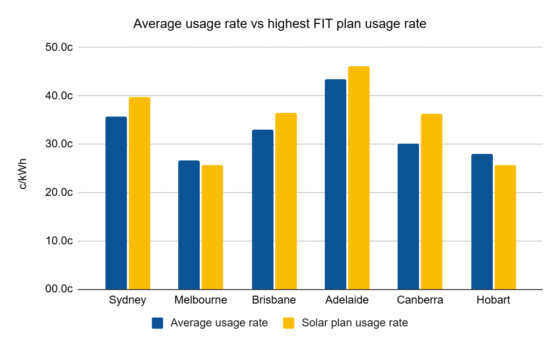
Source: Canstar. Average usage rates based on Ausgrid, Citipower, Energex, SA Power Networks, EvoEnergy and TasNetworks. Single rate electricity plans only.
Canstar’s data insights director, Sally Tindall, says, “Solar feed-in tariffs aren’t quite what they used to be, and unfortunately, this means some households might have to shift their solar strategy to keep up with the evolving market.”
“Making the most of your solar-generated power is now more about how you use it than what you get for it.
“Canstar research shows the highest solar feed-in tariffs from each provider on our database have, on average, almost halved in the space of 12 months in Victoria. In New South Wales, the slide is almost as dramatic, dropping by 34 per cent in just one year.
“For households focused on securing a competitive feed-in rate, it’s worth shopping around, but make sure you read through the entire offer. You want to be looking out for any caps on how much you can export at that higher rate, how much you might be paying to remain connected to the grid, and consider when you need to pay for electricity from the grid.
“Take the time to read through your energy bills and make sure the numbers check out. If you’re starting to think you’re on the bad side of a good deal, then it could well be time to switch to a plan that doesn’t cost you.
“A solar battery is another alternative for those who want to maximise more of the power they generate. While it is a significant investment, taking advantage of the government’s Cheaper Home Batteries Scheme could help lessen that cost, and, if you play your cards right, end up saving you more in the long run than if you had no battery at all.”

This article was reviewed by our Consumer Editor Meagan Lawrence before it was updated, as part of our fact-checking process.