







New electricity pricing has landed in the inboxes of households all over the country, with retailers letting customers know what their new rates will be from 1 July.
For some, the new rates have meant a drop to their usage rate – which is the rate charged for electricity used – while some have seen their supply charge increase significantly. Some price changes, seen by Canstar, have shown some households’ new supply charges increase by more than 70%.
The supply charge is the fixed cost households pay to be connected to the grid, every day.
Why are the electricity rates changing?
The change to how your energy is priced comes down to how the Australian Energy Regulator (AER) has set the default market offers (DMO) for the next financial year.
The latest DMO is different to previous years, with the regulator now specifying how retailers can set their costs on the different things that make up an energy bill.
The DMO is only responsible for setting the default offers, also called standing offers. However, because it acts as a benchmark for market plans, retailers have followed suit, with the new pricing mirroring what the standing offers are showing.
The result? A higher supply charge, but drops to your usage charge.
It’s not all bad – but that depends
This reweighting of energy tariffs isn't necessarily a bad thing - but it largely depends on how much energy your household uses in a day, with high usage households getting a slightly better deal.
This is because the drop in usage could be enough to balance out the increase to the supply charge.
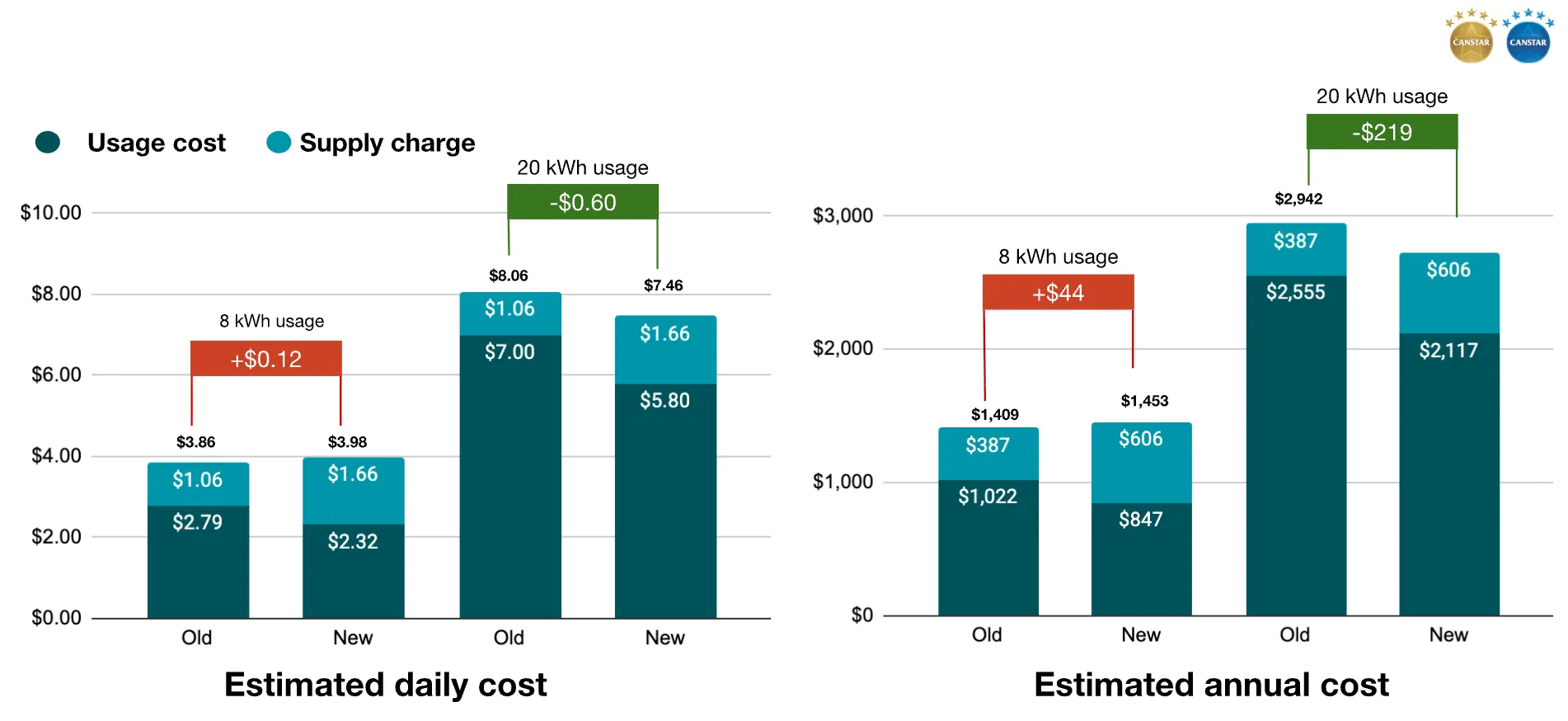
Here’s an example where there are two households, who have the exact same electricity rates, that are changing exactly the same.
Example rate changes:
Old | New | Difference | |
Usage rate | $0.35 | $0.29 | -$0.06 |
Supply | $1.06 | $1.66 | $0.61 |
If these households were to use the exact same amount of energy as they did for the last year, then this is what it would look like:
For the low energy-consuming household, the new rates would see them paying more, while the higher use household will actually see a drop.
What can you do about your new rates?
If you’re not sure about the look of your new rates, then it could be a good time to see if you can switch to a cheaper energy plan.
Taking a few minutes to compare your options could help you save. If you’re looking to switch:
- Check your bill's actual daily supply charge and usage rate
- Work out your household usage (low, medium or high)
- Compare your new rate against other plans on the market
For some reference, here are the current average and lowest usage rates and supply charges on the Canstar database across the capital cities.
Usage and supply rates for flat rate plans for each capital city | ||||
Usage rate (c/kWh) | Supply (c/day) | |||
Lowest | Average | Lowest | Average | |
Sydney | 26.4 | 33.9 | 88.0 | 135.5 |
Melbourne | 18.4 | 25.5 | 51.4 | 112.6 |
Brisbane | 26.2 | 29.6 | 103.9 | 165.9 |
Adelaide | 35.3 | 42.4 | 96.2 | 154.8 |
Hobart | 24.8 | 28.5 | 107.0 | 146.4 |
Canberra | 24.8 | 32.2 | 108.3 | 152.4 |
Source Canstar, 03/07/2026. Based on single rate electricity plans on Canstar's database. Regional energy networks will differ. | ||||
Ultimately, the changes to the electricity rates could turn out to be a win or a loss for your wallet, but it all depends on your household’s energy habits.
Even then, it’s worth remembering that loyalty rarely pays when it comes to electricity providers, so the smartest way for you to keep costs under control might be less about the energy you use, but the plan you’re on plan.