







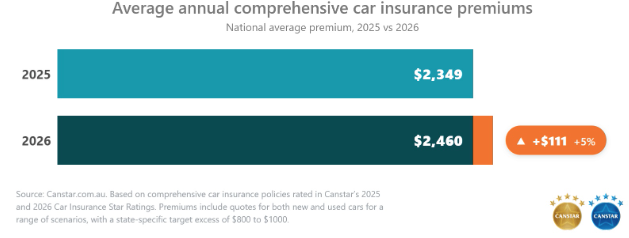
Car insurance costs continue to rise, with a new Canstar report showing the average comprehensive car insurance premium has risen by 5% or $111 over the past 12 months.
Yet drivers could save as much as 26% by switching to a cheaper provider, according to the research, which was based on over 56,000 quotes.
Older drivers hit with the biggest premium increases
Policies for drivers aged 50 or older have risen by the most at 10% year-on-year, while premiums for drivers aged 30 to 49 saw the steepest increase in dollar terms at $159 or 9%.
Premiums for drivers aged under 25 remained relatively steady in 2026, however, this cohort still pays the most overall at an average annual premium of $2,833 for females and $3,158 for males.
The gap between the age groups has narrowed over the past year, but young drivers are nowhere near catching a break.
Average annual | |||
|---|---|---|---|
Age | 2025 | 2026 | Change |
Under 25 | $2,830 | $2,833 | +$3 |
Under 25 | $3,157 | $3,158 | +$1 |
25 to 29 | $2,279 | $2,367 | +$88 |
30 to 49 | $1,682 | $1,841 | +$159 |
50+ | $1,316 | $1,451 | +$135 |
Source: Canstar. Based on comprehensive car insurance policies rated in Canstar's 2025 and 2026 Car Insurance Star Ratings. Premiums include quotes for both new and used cars for a range of scenarios, with a state-specific target excess of $800 to $1,000.
Victorians continue to pay the most for car insurance
Victorian drivers experienced the largest increase in car insurance premiums in dollar terms over the past 12 months and remain the most expensive state to insure a car, with the average comprehensive premium clocking in at $3,293 a year.
This is partly due to the high incidence of car theft in the state, as reported by the Insurance Council of Australia.
At the other end of the scale, Tasmania is the most affordable at $2,014 a year, even though it had the steepest percentage rise this past year. Queensland and WA saw the smallest increases across the states.

Average annual comprehensive | |||
|---|---|---|---|
State | 2025 | 2026 | Increase |
NSW | $2,676 | $2,792 | +$116 (+4%) |
QLD | $2,112 | $2,169 | +$57 (+3%) |
VIC | $3,101 | $3,293 | +$192 (+6%) |
SA | $2,069 | $2,145 | +$76 (+4%) |
WA | $2,148 | $2,208 | +$60 (+3%) |
TAS | $1,880 | $2,014 | +$134 (+7%) |
NT | $2,425 | $2,577 | +$152 (+6%) |
Source: Canstar. Based on comprehensive car insurance policies rated in Canstar's 2025 and 2026 Car Insurance Star Ratings. Premiums include quotes for both new and used cars for a range of scenarios, with a state-specific target excess of $800 to $1,000.
More than 1 in 4 drivers have never switched insurers
The Canstar report, which includes a survey of over 6,700 insured drivers, found 28% have never changed providers, potentially missing out on significant savings.

Switching could save average driver $651 on annual premium
The report found a driver paying an average comprehensive car insurance premium of $2,460 who switches to one of Canstar’s top-rated policies could potentially save $651 in one year, knocking this expense down by more than a quarter.
Average comprehensive | ||
|---|---|---|
Market | Average of | Difference |
$2,460 | $1,809 | -$651 |
Source: Canstar. Based on comprehensive car insurance policies rated in Canstar's 2026 Car Insurance Star Ratings. Premiums include quotes for both new and used cars for a range of scenarios, with a state-specific target excess of $800 to $1,000.
The savings potential can be even greater depending on where you live. Victorian drivers may be able to pocket around $835, while in NSW the average savings could be just over $800.
Average comprehensive | |||
|---|---|---|---|
State | Market | Average | Difference |
NSW | $2,792 | $1,991 | -$801 |
QLD | $2,169 | $1,750 | -$419 |
VIC | $3,293 | $2,458 | -$835 |
SA | $2,145 | $1,573 | -$572 |
WA | $2,208 | $1,675 | -$533 |
TAS | $2,014 | $1,505 | -$509 |
NT | $2,577 | $1,797 | -$780 |
Source: Canstar. Based on comprehensive car insurance policies rated in Canstar's 2026 Car Insurance Star Ratings. Premiums include quotes for both new and used cars for a range of scenarios, with a state-specific target excess of $800 to $1,000.
Canstar’s top-rated car insurance providers for 2026
Canstar’s Car Insurance Star Ratings and Awards highlight the providers offering outstanding value to Australian drivers, based on a comprehensive comparison of price and policy features.
The ratings help motorists identify high-performing policies, while the awards recognise insurers with the strongest overall performance across various driver types.
This year, policies from 39 car insurance providers were rated, identifying three Outstanding Value Award winners:
- National: AAMI, Bingle, and ROLLiN’ Insurance
- NSW, QLD, TAS, and NT: ROLLiN’ Insurance
- VIC, SA, and WA: AAMI
Other ways to save on car insurance
- Paying annually instead of monthly can make a difference: Canstar’s research found 62% of providers offer a discount for paying annually as opposed to monthly. Switching to an annual payment option could save drivers around $300 a year on average.
- Increasing your excess: Choosing a higher excess can help reduce the premium, but it also means the driver will need to pay more out of pocket if they make a claim. Canstar’s analysis found that increasing an excess from $600 to $1,000 could save drivers as much as $400 a year in some cases.
- Consider pay-as-you-drive: Drivers who travel less could also save. Reducing annual kilometres from 15,000km to 10,000km could save as much as $200 in some cases, while cutting to 5,000km could save as much as $400. Exceeding nominated kilometre limits may result in additional excess charges.
Canstar’s Data Insights Director, Sally Tindall, says, “Car insurance premiums are headed into overdrive, with Canstar’s latest report finding costs have risen once again, this year by 5 per cent.”
“What’s astounding is that more than one-quarter of Australian motorists have stuck devotedly to their insurer, despite the premium price hikes.
“With the average driver potentially able to pocket $650 by switching to a top-rated policy, it’s time to stop letting auto-renewals drain your wallet and actively change gears.
“A rise in car theft is driving up insurance costs in Victoria. Motorists in this state are, on average, paying the highest comprehensive car insurance premiums across the country at $3,293. However, Victorian drivers also have the most to gain by shopping around, with potential savings scaling up over the $800 mark if they switch from an average-priced policy to a five-star rated alternative.
“Older motorists have been hit particularly hard, with drivers aged 50 and over seeing average premiums jump by 10 per cent over the past 12 months. Meanwhile, drivers aged 30 to 49 recorded the largest dollar increase, paying an average of $159 more than they were a year ago.
“Many drivers automatically renew their policy each year without checking whether it still stacks up. Taking the time to compare policies before your renewal date could put hundreds of dollars back in your pocket.
“Beyond switching providers, there are other ways you may be able to lower your premium. Paying annually rather than monthly, increasing your excess, or accurately updating your annual kilometre estimate can potentially help reduce costs.
“Before making changes to your policy, make sure you understand the trade-offs involved. A lower premium can be attractive, but it’s important that your cover still provides the protection you need if you have to make a claim.”