

Bill relief on the way? Victorian energy regulator proposes electricity price drop

 12 Mar 2026
Victorian households could see their annual electricity bills drop by an average of $46 next financial year, following a proposal by the state’s energy regulator to lower benchmark prices.
The Essential Services Commission has today announced the draft benchmark prices for 2026-27, proposing a reduction across each of the state’s five electricity networks.
Prices on the Powercor network are set to fall the most, with a $48 annual reduction for an average household, if the draft determination is accepted.
The Victorian Default Offer is a safeguard for those who can’t or don’t shop around for their electricity, with 17% of households on these plans. The prices also act as a benchmark for the Victorian market.
The final prices will be determined in May and change on 1 July 2026.
← Mobile/tablet users, scroll sideways to view full table →
| Victorian default electricity prices | ||||
|---|---|---|---|---|
| Distributor | Current annual price | Proposed 2026-27 price | Change | |
| AusNet | $1,908 | $1,863 | -$45 | -2% |
| CitiPower | $1,546 | $1,500 | -$46 | -3% |
| Jemena | $1,638 | $1,592 | -$46 | -3% |
| Powercor | $1,703 | $1,655 | -$48 | -3% |
| United Energy | $1,579 | $1,536 | -$43 | -3% |
Source: ESC. Prepared by Canstar. Prices are estimates for an average household using 4,000 kWh/yr on a flat tariff on the default offer.The draft default prices for New South Wales, South Australia and south-east Queensland, are set to be published later this month by the regulator in these states.
What is driving the drop in prices?
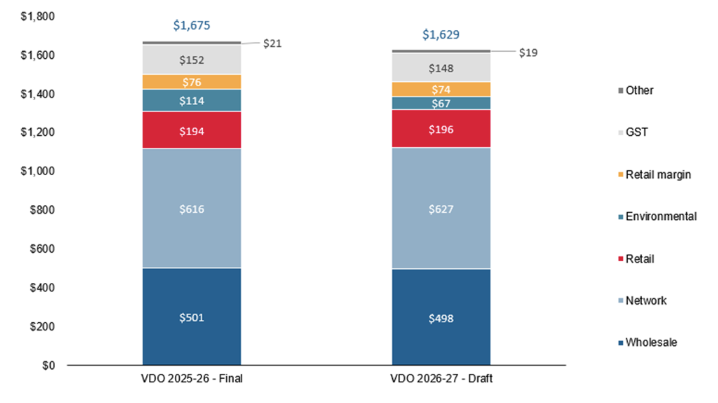
The primary driver behind the proposed price reduction is a significant drop in environmental costs, that is, the cost companies have to pay to support state and federal renewable energy programs.
For a typical home, these costs will plummet from $114 this financial year to $67 in 2026-27 – a 41% reduction. Other expenses, in particular, the cost of buying wholesale power, have largely stayed the same (see graph at end).
Next steps
While the Victorian regulator has proposed reductions of up to 3% for electricity prices in 2026-27, the final determination could result in a different outcome when announced on 24 May.
Canstar analysis shows that last year, the final price determinations for four of the five networks were higher than the draft prices originally proposed.
| Difference in draft vs final default prices: 2025-26 | |
|---|---|
| AusNet | +$25 |
| CitiPower | +$22 |
| Jemena | -$42 |
| Powercor | +$23 |
| United Energy | +$10 |
Source: ESC, prepared by Canstar.
Households can potentially get a bigger discount from shopping around
The regulator might be pushing for a drop in electricity prices from 1 July, however, customers on a default offer can potentially do much better than this by switching plans and providers, provided they are not on an embedded network.
Canstar analysis shows if a typical household in Melbourne switched from the default market offer electricity plan to the lowest on the Canstar database, they could potentially save $347 over the next year.
A typical household on the AusNet network could save as much as $409 – that’s nine times the proposed reduction to the default offer prices.
← Mobile/tablet users, scroll sideways to view full table →
| Potential annual savings from switching from the default price to lowest electricity plan | |||
|---|---|---|---|
| Default price | Lowest | Savings | |
| Ausnet Services | $1,908 | $1,499 | $409 |
| Citipower | $1,546 | $1,199 | $347 |
| Jemena | $1, 638 | $1,300 | $338 |
| Powercor | $1,703 | $1,300 | $403 |
| United Energy | $1,579 | $1,200 | $379 |
Source: Canstar – 12/03/2026. Based on single rate electricity plans on Canstar’s database; excluding solar-only plans. One product shown per distribution network. Annual costs calculated based on the estimated lowest possible price a representative customer would be charged in a year, assuming all conditions of discount offered (if any) have been met. Representative customer based on the reference usage for VIC.
New rules to protect long-term customers from unfair loyalty tax
From 1 July, energy retailers must make sure that customers who have been on the same plan for more than four years are paying a “reasonable price”. If not, the provider must move them to a cheaper plan.
Other rule changes to come into effect in October 2026 include:
- Customers having trouble paying must be moved on to a provider’s cheapest plan.
- Retailers must offer payment methods other than direct debit for each plan.
- Retailers must check if customers are eligible for concessions at key times.
Canstar’s data insights director, Sally Tindall, says, “What a relief this will be for households across Victoria if the draft determination is finalised as is.”
“Who would have thought electricity prices would be the bill to break the price-hike trend, but that’s exactly what the regulator is proposing.
“Meeting government renewable targets has become cheaper for the retailers and the regulator wants to pass these savings on to households.
“That said, households shouldn’t take this news as a done deal. Canstar analysis of past draft decisions shows the final price can sometimes creep up after negotiations with market participants, with the final determination not due until the end of May.
“While any drop in electricity bills is welcome, the reality is that the default offer is still far from the cheapest option.
“Canstar’s analysis shows that a typical Melbourne household could save more than $300 simply by switching to the lowest-priced plan.
“Those that can shop around, absolutely should.
“The new rule coming in from July 2026, which forces energy retailers to move customers on older plans to cheaper options, is a huge step forward. Penalising loyalty is a concept that has become entrenched in the way so many bills operate.
“This rule, and the other reforms coming down the line designed to help people in hardship, won’t fix everything, but they will make the system fairer.”
What makes up Victorian electricity costs? The breakdown between 2025-26 and 2026-27

This article was reviewed by our Consumer Editor Meagan Lawrence before it was updated, as part of our fact-checking process.