







Household spending rose by $2.1 billion in March to a record $90.5 billion, but the lift was driven less by consumers opening their wallets and more by higher costs across everyday essentials.
Canstar's analysis of today’s RBA credit and debit card figures for March 2026, shows debit card spending ramped up a notch, hitting the highest level in the history of the dataset, in seasonally adjusted terms at $60.5 billion.
Credit card spending clocked in at $30 billion for the month – the second-highest level in RBA records, behind a bumper spend in January.
Value of card | |||
|---|---|---|---|
Amount | Monthly | Annual | |
Debit cards | $60.5 | +1.7 +3% | +$7.3 +14% |
Credit cards - | $30.0 | +$411 +1% | +$1.7 +6% |
Total | $90.5 | +$2.1 +2% | +$8.9 +11% |
Source: RBA credit card statistics, personal cards, March 2026, released 7 May 2026, seasonally adjusted data.
Australians not going to town, just getting around town
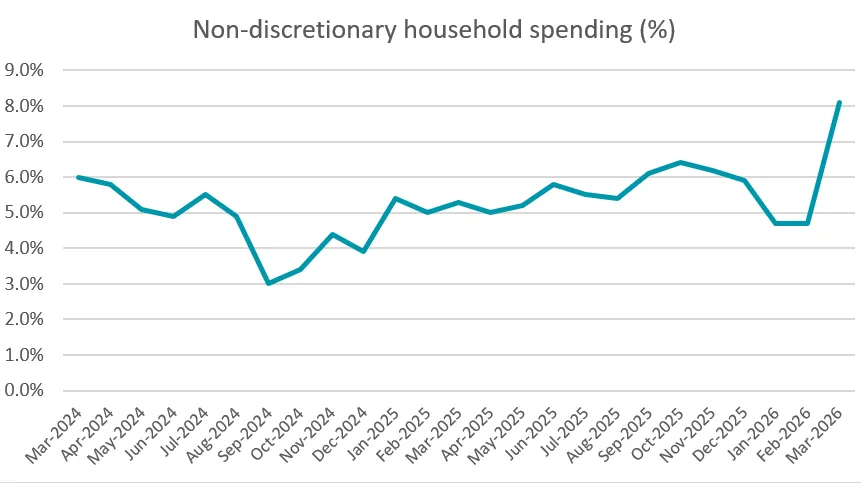
Today’s figures reflect this week’s ABS Monthly Household Spending Indicator, released Tuesday, which showed spending on essentials rose 8.1% through the year to March, the largest increase in non-discretionary spending since September 2023.
This was led by the spike in fuel costs which ABS inflation data shows rose by 32.8% in the month of March.
Debt accruing interest stabilises in March
Credit card debt accruing interest rose by a relatively-minor $62 million, up 0.3% from the previous month, leaving the total bill attracting interest charges across all personal credit cards at $19.7 billion, in original terms.
Credit card debt | |
|---|---|
Amount - | Monthly |
$19.7 billion | +$62 million +0.3% |
Source: RBA credit card statistics, March 2026, released 7 May 2026, original data terms, excludes commercial cards. Year-on-year analysis not available due to a series break in November 2025.
Cost-of-living pressures likely to ramp up in coming months
Canstar's Data Insights Director, Sally Tindall, says, “Australians didn’t so much open their wallets in a spending spree in March, but rather were forced to dig deeper into them, with skyrocketing fuel prices driving up the cost of everyday living.”
“This is not a story of Australians splashing out, so much as a story of Australians having to pay more for the basics. The ABS Monthly Household Spending Indicator for March shows, while spending on discretionary items rose by an annual rate of 5.3 per cent, spending on essentials rose an eye-watering 8.1 per cent.
“What we didn’t see in the March data was a surge in credit card debt. That said, with the total amount attracting interest charges sitting just below $20 billion, it's still a significant financial stranglehold on many family finances.
“With the RBA warning cost-of-living pressures are likely to ramp up in the months ahead, now’s the time to pull out all stops to knock it down any high-interest debt.
“That could mean making a big call such as selling the second car, or taking on extra work temporarily. With a recession potentially looming in the wings, getting your finances in the best shape possible should be a priority.”