






Cash use is on the rise according to new RBA data released today, despite a continued drop in ATMs and bank branches.
The RBA report found 15% of payments were made in cash in 2025, up from the 13% recorded in 2022 in the central bank’s triennial Consumer Payments Survey.
The 2025 survey found:
- 15% of all transactions were made in cash. In dollar terms, cash accounts for 8% of all purchases (see full breakdown at end).
- 50% of Australians use cash in a typical week.
- 1 in 4 (27%) payments under $10 are made in cash.
- High cash users are dropping. Around 7% rely on cash for at least 80% of their transactions, down from 8% in the 2022 survey.
- Older Australians and those living in regional areas are more likely to use cash.
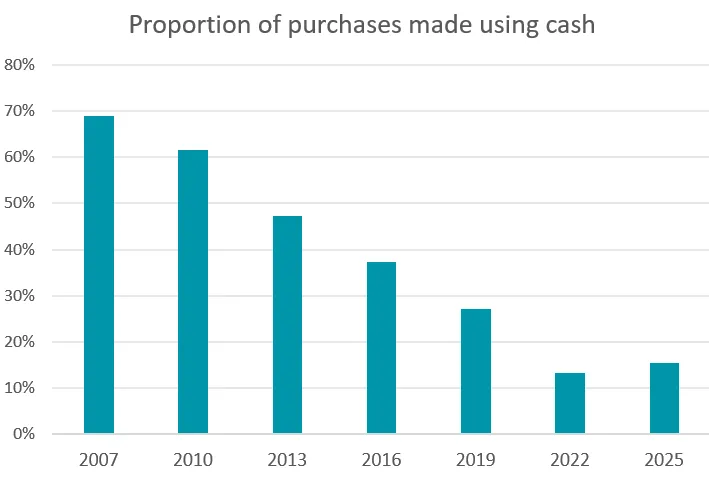
Source: RBA, based on data from Colmar Brunton, Ipsos and Roy Morgan Research; prepared by Canstar.
Majority of Australians still carry cash
The RBA report found 75% of Australians still carry cash, the median amount of which is $65. The main reason people said they carry cash:
- in case of emergency / unexpected purchase (28%)
- for when electronic payment systems go down (16%)
- for gifts and / or pocket money (12%)
While many people carry cash in case of emergency or system failure, the primary reason they actually use cash is when a shop or other provider doesn’t accept card payments (33%).
However, increasingly, people are opting to use cash for budgeting purposes, with 15% of people saying it's the main reason they use cash. This is up from an estimated 11-12% in the 2022 survey.
RBA ATM data shows the amount of cash withdrawn from ATMs around the country each month is on the rise, with a total of $9.3 billion withdrawn from ATMs in February alone. This is an increase of 3% from the previous year and 5% from 5 years ago.
Value of | ||
|---|---|---|
Amount - | Change from | Change from |
$9.3 billion | +$313 million +3% | +$413 million +5% |
Source: RBA, February 2026, released 7 April, seasonally adjusted data.
Easy access to cash on the decline
Cash is harder to access due to the decline in ATM and branch numbers across the country.
The 2025 RBA survey found 23% of people said they did not have convenient access to cash, an increase from 13% in 2022, while 36% say they do not have convenient access to cash deposit services, up from 33% in 2022.
Canstar’s analysis of APRA’s Points of Presence data for the last financial year shows the number of bank ATMs has dropped by a gigantic 47% in the last five years, while the number of bank branches has dropped by 33%.
Australian Payments Network data shows all ATMs dropped by 14% compared to five years ago.
Number of bank branches | ||
|---|---|---|
Number | Change from | |
Bank | 3,205 | -1,564 -33% |
Bank | 5,143 | -4,478 -47% |
All | 23,363 | -3,919 -14% |
Source: APRA, AusPay Network, analysed by Canstar. Bank data from June 25 vs June 20. All ATM data from Sept 25 vs Sept 20.
Canstar Data Insights Director, Sally Tindall, says, “This RBA survey is proof that while cash may no longer be king, it’s certainly not going the way of the cheque.”
“In fact, in a world that’s gone digital-first, cash is proving to be remarkably resilient. For the first time in the survey’s almost two-decade long history, we’re seeing a rise in the use of cash, despite the convenience of tapping a phone or a watch.
“Cash is increasingly becoming a deliberate budgeting tool. The RBA survey found 15 per cent of people are using cash to keep their spending in check, with trends such as cash stuffing helping them physically track their spending.
“Cash might have made a comeback but accessing it has not. The report found one in four Australians can’t withdraw cash easily, as the number of ATMs and bank branches continue to drop.
“Over the last five years of data, the number of bank branches has fallen 33 per cent, bank-owned ATMs, almost halved, while the entire ATM network has shrunk by 14 per cent. That’s a landslide that’s no longer reflective of cash use in Australia.
“The surcharge ban, set to come into effect in less than six months, will impact cash use to a degree. Canstar research found 33 per cent of Australians pay with cash just to avoid paying a surcharge.
“However, this won’t spell the end of cash, with the RBA survey showing there’s a huge range of reasons people pay with cash whether that’s for budgeting purposes, to pay the kids’ pocket money or for privacy reasons. Based on these survey results, cash isn’t going anywhere, anytime soon.”
Proportion of purchases | |||||
|---|---|---|---|---|---|
By | By | ||||
Year | All | In-person | Year | All | In-person |
2007 | 69% | 73% | 2007 | 38% | 47% |
2010 | 62% | 67% | 2010 | 29% | 43% |
2013 | 47% | 55% | 2013 | 18% | 32% |
2016 | 37% | 43% | 2016 | 18% | 30% |
2019 | 27% | 32% | 2019 | 11% | 19% |
2022 | 13% | 16% | 2022 | 8% | 13% |
2025 | 15% | 19% | 2025 | 8% | 16% |
Source: RBA, based on data from Colmar Brunton, Ipsos and Roy Morgan Research.