






Australian households could save a collective $1.9 billion annually by simply acting on the ‘better offer’ notification located on the front page of their electricity bills, Canstar analysis of ACCC data has revealed.
Electricity companies are legally required to include a message on a customer’s bill to tell you whether you’re on the provider’s lowest-priced plan.
ACCC data shows this message is on the bills of 6.7 million customers across Australia - 73% of households in the report.
How much could be saved?
Data from the ACCC shows customers not on their provider's lowest-priced plan stand to save an average of $291 and as much as $490 a year.
Canstar analysis has found collectively, this savings could top $1.9 billion.
By switching within the same provider, households can begin saving immediately - a move Canstar research shows 16% of customers have already made.
Total potential savings for customers switching to better/best offer | ||
|---|---|---|
No. of customers NOT on better offer | Average savings per customer | Total potential savings |
6,664,142 | $291 | $1,939,265,322 |
Source: ACCC Inquiry into the National Electricity Market Report, Dec 25. Analysis by Canstar.
Same electricity plan name is not a guarantee you’re on the lowest plan
The ‘better offer’ notification must appear on the front page of a bill at least every 100 days to tell customers whether they are on the lowest-priced plan from their provider, based on their electricity use.
This applies to customers in New South Wales, south east Queensland, South Australia, Tasmania and the ACT and has been in place since 2023. In Victoria, providers have been required to print this message at least quarterly since 2019.
Confusingly, 1.8 million customers are on a plan that has the exact same name as their provider’s cheapest option, but pay higher rates. In these cases, retailers must explain that the better offer is for a newer version of that plan.
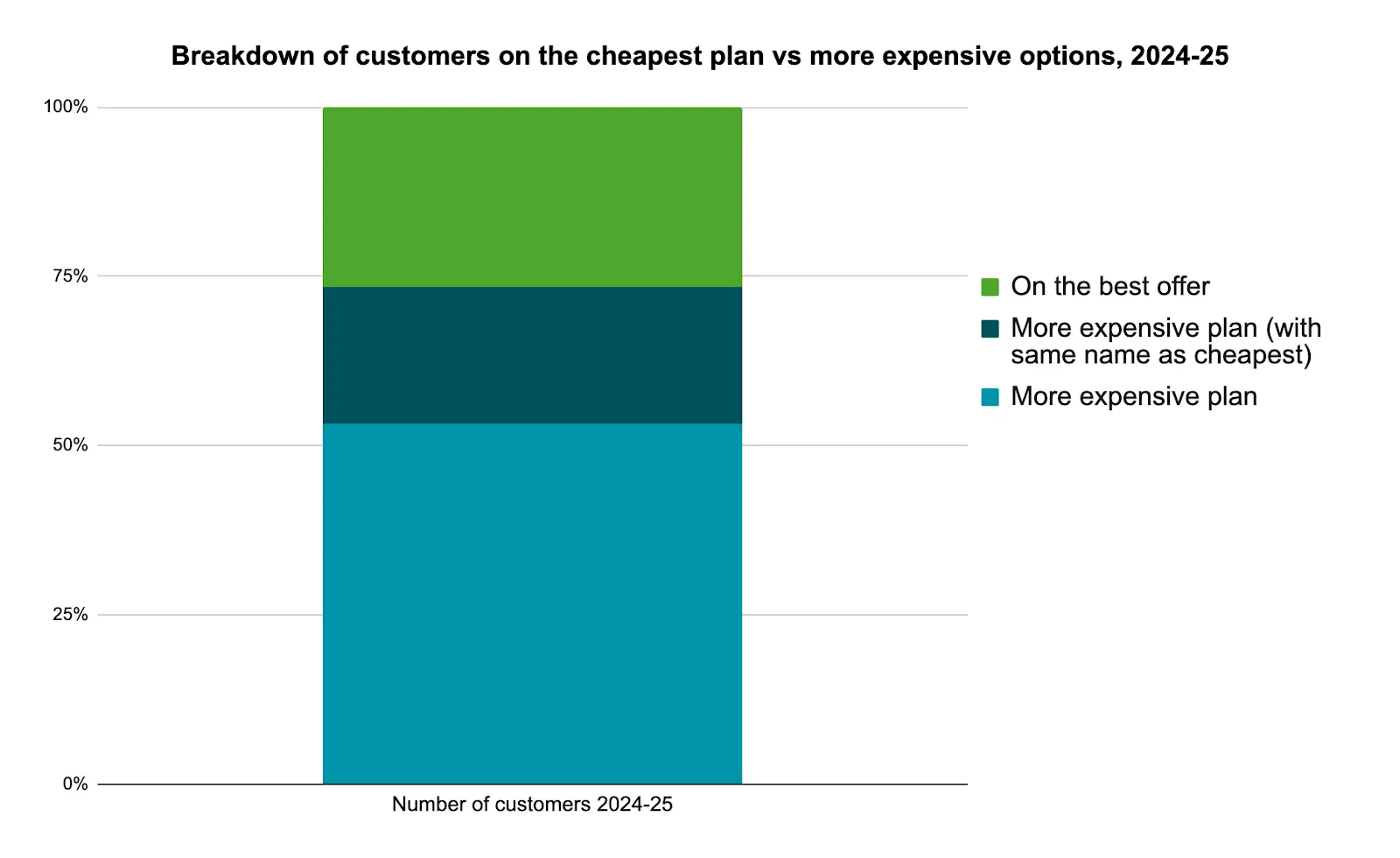
- 2.4 million customers (27%) are on the cheapest offer available from their provider.
- 6.7 million households (73%) are not on the cheapest offer.
- Of those not on the best offer, 1.8 million customers (27%) are on a plan with the same name as the cheapest.
New rules are set to come in on 30 December 2026 requiring providers to put the ‘better offer’ message in the body of the email, rather than solely in the attached bill.
How to switch to a better offer
- Step 1: Check your bill. Details on whether you’re on the cheapest plan from your provider will be in a box on the first page. If you aren’t, the amount you could save a year will also be listed.
- Step 2: Visit your provider's site to find the cheapest option for your household. If you’re not sure, ask.
- Step 3: Call, or send an email to your provider asking to switch to the cheapest option.
- Step 4: Review options beyond your provider. Canstar analysis shows that moving from an average plan to a market-leading one could in some cases save up to $389 (see table at end).
Canstar. data insights director, Sally Tindall, says, “It is staggering to think that $1.9 billion is sitting on the table simply because we haven’t taken up the offer that’s on the front page of our bills.”
“The 'better offer' notification was designed to be a red flag, however, the ACCC’s figures show more than 6.6 million customers have walked straight past it.
“The end of the federal electricity rebates has pushed some households into bill shock, however, most can manufacture their own discount today with just one phone call.
“The rules state the best deal from your provider must be printed in black and white on your bill, but you have to act on it in order to pocket the savings.
“With an average annual savings of $291 on the table, it could be the difference between clearing the winter electricity bill and having to call up and ask for hardship options.
“Once you’ve switched to the most competitively-priced plan, don’t stop there. Canstar analysis shows a typical household could save almost $400 in the next year in cities such as Adelaide and Canberra by moving their business to a provider willing to offer them market-leading rates.”
Potential savings switching from average to lowest cost electricity plan over one year | |||
|---|---|---|---|
Average | Lowest | Savings | |
Sydney | $1,754 | $1,488 | +$266 |
Melbourne | $1,440 | $1,199 | +$241 |
Brisbane | $1,969 | $1,654 | +$315 |
Adelaide | $2,146 | $1,757 | +$389 |
Canberra | $2,416 | $2,032 | +$384 |
Hobart | $1,343 | $1,229 | +$114 |
Source: Canstar - 15/04/2026. Based on single rate electricity plans on Canstar's database; excluding solar-only plans. One product shown per distribution network. Annual costs calculated based on the estimated lowest possible price a representative customer would be charged in a year, assuming all conditions of discount offered (if any) have been met. Representative customer based on the reference usage for NSW, VIC, QLD, ACT, and SA (per Victorian default offer for VIC, ICRC for ACT, and AER for others) or the median usage in the Office of the Tasmania Regulator's report, Typical Electricity Customers in Tasmania 2025 for TAS.