





What is a SIM card?
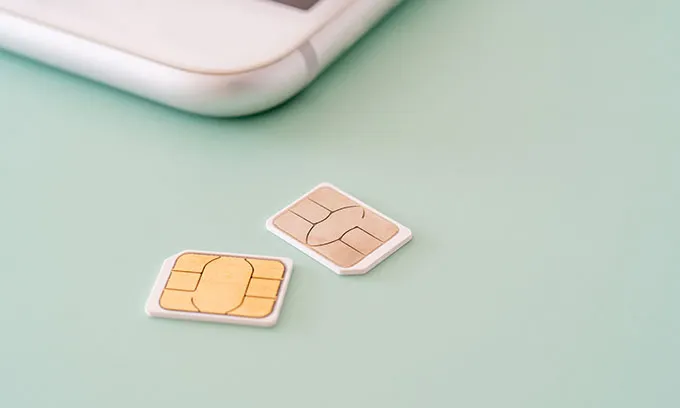
A Subscriber Identity Module (SIM) card is a microchip that contains details about your mobile phone account and grants you access to your provider’s network.
It’s linked to your mobile number and can be used in a compatible phone to make and receive calls and texts, as well as use data, depending on the type of SIM card purchased.
A SIM card corresponds to a specific mobile plan provider. If you decide to switch providers, you will need a new SIM card from your new provider. You can, however, keep your current mobile phone number by porting it to your new SIM.
What is an eSIM?
An embedded SIM (eSIM) removes the need for a physical SIM to be inserted into your phone. An eSIM is a chip that is built into a phone that allows you to change providers without having to swap physical SIM cards. Instead, software allows you to change providers instantly online.
eSIM technology also allows for multiple SIMs to be stored on a compatible phone. This allows you to use more than one number, making it easy to switch between providers (for example, when travelling overseas).
While eSIMs are built in to the phone, they still require activation. To get your eSIM up and running, you’ll need to buy an eSIM-compatible mobile plan and follow the onscreen prompts. Note that you may need to download a mobile provider’s app to activate your eSIM.
Which providers offer eSIM in Australia?
Here’s a range of popular telcos currently offering eSIM:
- AGL
- Amaysim
- Boost Mobile
- Everyday Mobile
- Felix
- iiNet
- Kogan Mobile
- Lebara
- LycaMobile
- Mate
- More
- Optus
- Southern Phone
- SpinTel
- Superloop
- Tangerine
- TeleChoice
- Telstra
- TPG
- Vodafone
What is the difference between an eSIM and regular SIM cards?
The main difference between an eSIM and a regular SIM card is that eSIMs aren’t physical, while you can physically hold a SIM card in your hand. eSIMs tie your smartphone to the plan you’ve signed up to via a chip in the motherboard, so an eSIM and traditional SIM card still work in the same way.
The only other main difference is that eSIMs require more tech to run on a smartphone, which is why some smartphones aren't eSIM compatible.
While eSIM is a quicker way to connect to a new phone plan, there are several other benefits to choosing an eSIM over a physical SIM.
- Travel overseas: There’s no need to hunt around for a SIM card if you’re travelling overseas; simply find an eSIM travel plan either before you leave or while overseas. This allows you to keep your Australian plan active, so there’s no need to remove your SIM card.
- Link your smartwatch: You can accept calls on your watch when you’re out and about, even without your phone with you (however the watch will need to be eSIM compatible).
- Keep business separate: The dual SIM feature means you can keep two numbers on the same phone and potentially turn off one number outside business hours, or choose to ignore that call.
What types of SIM plans are there?
Prepaid SIM
A prepaid SIM card gives you access to a prepaid SIM-only plan, which means you’ll pay for your usage in advance and then ‘recharge' your service at the end of each expiry period. Prepaid plans come with several expiry options, including short term (seven-day), standard (28-day, 30-day or monthly) or long term (starting at 90-day and up to 365-day/12-month) expiries.
Prepaid SIM cards are available online from prepaid providers, plus from a range of retailers including telcos, supermarkets and convenience stores.
Postpaid SIM
Postpaid SIM cards allow you to use a postpaid SIM-only plan, so you’ll receive a bill for your usage at the end of each month. Unlike prepaid SIMs, you won’t need to recharge a postpaid SIM plan — you can just pay your monthly bill and continue to use your plan.
Postpaid SIM cards are also available online and from telcos, supermarkets and other retailers.
Data-only SIM
A data-only SIM plan is a plan that includes only data. This means that it doesn’t come with call or text inclusions. These kinds of plans are typically used for WiFi dongles or tablets: however, they can still work in mobile phones if you aren’t looking to make calls or texts. Keep in mind that these plans are not suitable replacements for a mobile phone plan as you’ll still need a phone number and the ability to receive text messages for things like online banking and two-factor authentication checks.
As with other SIM card types, data-only SIMs can be picked up from retailers and online.
SIM card sizes
As smartphone technology advances, SIM card sizes have reduced. However, larger SIM cards are still being used in some smartphone models, as well as devices such as modems or hotspots.
Apart from physical size, there isn’t any difference between SIM cards. Each is capable of doing the same job, but are simply different sizes to fit into different phone models.
The three different SIM card sizes in Australia are:
- Mini (also known as standard): Standard SIM cards are the biggest SIM you’ll see these days, and are mostly used in larger devices which are more concerned with ease of use than saving space.
- Micro: Roughly half the size of a standard SIM, micro SIMs are used in many older Android mobile phones, as well as the earlier generations of iPhones.
- Nano: Originating with the iPhone 5 in 2012, the nano SIM size is now the standard size for new smartphones. The nano SIM is almost all circuit with hardly any plastic bezel.
Currently, just about all mobile service providers issue customers with a 3-in-1 SIM card (also known as a combi SIM, universal SIM or triple-cut SIM). The micro and nano SIM sizes are contained within the standard SIM – all you need to do is pop out the one that fits your device.
How to activate a SIM card
Once you’ve bought your new SIM card, you’ll need to remove your existing SIM and replace it with your new one. The SIM-card tray location will vary model to model, but once you’ve found the SIM tray on your device, general replacement instructions are usually the same:
- Turn your device off completely.
- Insert the SIM tool that came with your phone (alternatively, you can use a thin paperclip) into the small hole on the SIM tray until it pops out
- Pop the card out of its plastic packaging and insert it into your phone.
- Slide the tray back into your phone and turn your device back on.
- Activate your new SIM card by using its accompanying activation key (this will be included in the package). You’ll need an internet connection for this (use a computer or your WiFi).
- Wait some time, and it should activate shortly.
- Make sure you read the instructions accompanying your new SIM carefully, in case an extra step is necessary.
Keep in mind that if you're porting your phone number to your new SIM, there may be some additional steps during the activation process.
What are dual SIM phones?
Dual SIM phones are smartphones that can hold two SIM cards at once.
Some models are only ‘single configuration’ meaning you can only use one SIM card at a time and have to switch to the other SIM in your phone’s settings.
Other models will allow you to use both SIM cards at once, which is useful if you want one SIM for personal use and the other for work.
Many dual SIM smartphones have the primary SIM slot, and a hybrid slot, which can be used for a second SIM or a micro SD card. Some phones considered dual SIM may only have one physical SIM card slot, but will also support eSIM, meaning you can use a physical SIM and an eSIM simultaneously.
Dual-SIM phones in Australia
Some of the most popular dual SIM smartphones include:
Apple |
|
|---|---|
Samsung |
|
| |
OPPO |
|
HMD/Nokia |
|
Motorola |
|
Where to buy a SIM card
Many retailers and online stores sell SIM cards offering different plan options, so it’s worth shopping around to find the best deal for you.
Telcos
The three main Australian telcos each have physical and online stores that sell SIM cards and eSIMs that permit access to their mobile phone networks:
- Telstra
- Vodafone
- Optus
You can also order a SIM card and mobile phone plan online through a telco’s website. Smaller telcos may only offer SIM cards online via their website, or in-store through other retailers.
Electronics retailers
Most large electronics retail chains sell varying SIM cards:
- JB Hi-Fi
- Officeworks
- The Good Guys
- Harvey Norman
- Kmart
Service stations
Many petrol stations sell a range of SIM cards from major telco providers, usually as prepaid options:
- 7-Eleven
- BP
- Coles Express
- Ampol
Supermarkets
Three of Australia’s major supermarkets sell a range of SIM cards, but also have their own mobile network services:
Coles
Coles Mobile plans use the Optus network, with its mobile plans available for purchase at all Coles supermarkets and Coles Express sites across Australia. Coles offers a range of prepaid plans or postpaid monthly plans, all of which include international call inclusions and data banking.
Woolworths
Everyday Mobile, formerly known as Woolworths Mobile, offers a range of plans using the Telstra mobile network, with SIMs available online or in Woolies stores. Prepaid plans are available over 30-day or long expiry periods all of which include unlimited standard national talk and text and data banking of up to 500GB or 1000GB of data (depending on the plan). Everyday Mobile also offers SIM-only postpaid plans. Some plans also include a 10% discount on one in-store Woolies shop each month when linking an Everyday Rewards card.
ALDI
ALDI offers a range of options via its ALDI Mobile service, with plans operating on the Telstra network. The plans are broken up into three categories – standard 30-day prepaid, multi-user family plans, and Pay As You Go (PAYG) plans. With ALDI you can start by purchasing a SIM card and PAYG recharges in-store or online.
Which SIM card should I get?
Which SIM card you choose to purchase will depend on which provider and plan you choose, your device and how you plan to use your mobile phone.
You will need to evaluate how much you want to spend on your mobile plan, which provider offers the best coverage in your area and your data usage needs before deciding on which provider you will buy your SIM and plan from.