




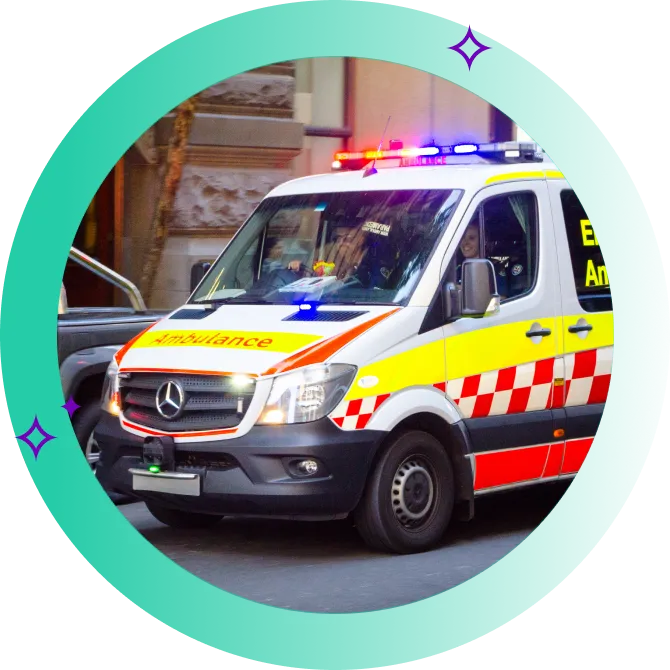
























What is ambulance cover?
Ambulance cover is a form of health insurance that’s designed to help cover the costs of being provided with ambulance services when required. Ambulance services are not covered by Medicare in Australia, but in states like Queensland and Tasmania, ambulance services are fully funded by the government—meaning there’s no cost to the residents of those states in certain circumstances. In other parts of the country—New South Wales, for example—users are required to contribute to the cost of the services and may want to consider a level of ambulance cover to protect themselves financially if they need to use the service.
Health insurance cover for ambulance services can take a few different forms. Some health insurers offer a standalone ambulance cover product, whereas most simply cover ambulance costs under their hospital or extras products.
Even if you’re covered for the costs of ambulance assistance, once the ambulance gets you to the hospital, you may need cover for the further medical assistance you’re given, depending on factors like which hospital you go to (whether it’s private or public) and the types of treatment you receive. This means you may want to consider having a broader level of health insurance if you plan to be a private patient while in hospital.
How do ambulance services work in NSW?
Ambulance services in New South Wales are provided by NSW Ambulance. The cost of providing the services are subsidised by 49% for NSW residents by the state government. This means that even if you do not qualify for any exemption or concessions on the ambulance costs you’ve incurred, or you’re not covered by private health insurance that includes ambulance cover, you’ll still only have to pay 51% of the total costs if you’re a NSW resident.
If you are in Australia and need an ambulance, call Triple Zero (000).
How do I get ambulance cover for NSW?
There are a number of ways you can get coverage for ambulance services in NSW, including a private health insurance policy, a school/group contributions scheme or via workers compensation/third party insurance.
Private health insurance ambulance-only cover
Eligible private health ambulance only policies provide cover for the cost of ambulance services in NSW. Depending on the policy, it may cover emergency ambulance services only (transport and any paramedic care provided) or both emergency and non-emergency services. Policies may also apply within the state of NSW only or Australia wide. This cover typically only applies to ambulance services provided by the recognised state-based provider (i.e. NSW Ambulance).
Some things you should consider when taking out an ambulance policy include:
- Does the policy cover ambulance services over air and sea or just road?
- Are there any limits on how much you can claim within a set period?
- What waiting periods apply between the time you take out the policy and when you can make a claim—bearing in mind that the waiting periods may be different for emergency and non-emergency ambulance cover?
It’s important to keep in mind that ambulance cover only applies to the cost of the ambulance service and generally does not cover care you receive at the hospital—if you wish to be treated as a private patient.
Private health insurance hospital or extras policy with ambulance cover
If you would like to be covered for ambulance services in NSW as part of a broader health insurance policy, you could consider a hospital and/or extras policy that includes a level of ambulance cover. If you already have health insurance in place, consider checking whether ambulance cover is included and to what level (e.g. Does it cover emergency and non-emergency ambulance services? Does it apply in NSW or nationally?).
School/Group Contributions Scheme
School groups in NSW can get ambulance service coverage directly from NSW Ambulance. According to NSW Ambulance, this provides cover for ambulance services provided to children who are injured or become ill while engaged in an approved school activity—subject to some conditions. The scheme also provides coverage to children attending groups such as Child Care Centres, Long Day Care Centres (LDCC), Out of School Hours (OOSH), Vacation Care, Pre-school, Family Day Care (FDC) and Pony Clubs.
Workers compensation/third party insurance
In certain circumstances, Compulsory Third Party (CTP) or workers compensation insurance may cover eligible ambulance services, NSW Ambulance says. It may be worth checking with your insurance provider or your employer about any coverage you may have. You may also be covered if you are eligible for a scheme provided by the Lifetime Care and Support Authority.
How much do ambulance services cost in New South Wales?
According to NSW Ambulance, the cost of ambulance services in New South Wales are as follows:
For NSW residents
| Road - emergency | Road - non-emergency | Fixed wing - emergency | Helicopter - emergency |
|---|---|---|---|---|
Call-out | $464 | $365 | $464 | $464 |
Variable rate (per km) | $4.18 | $2.26 | $4.18 | $4.18 |
Maximum charge | $7,601 | $7,601 | $7,601 | $7,601 |
Source: NSW Ambulance 25/11/25.
These fees take into account the NSW Government’s 49% subsidy at the time of writing. Whether your private health insurance will cover all or some of the above fees will ultimately depend on your policy. You can check your policy’s Private Health Information Statement (PHIS) or contact your insurer directly for more information.
For non-NSW residents
| Road - emergency | Road - non-emergency | Fixed wing - emergency | Helicopter - emergency |
|---|---|---|---|---|
Call-out | $909 | $365 | $909 | $909 |
Variable rate (per km) | $8.20 | $2.26 | $8.20 | $8.2- |
Source: NSW Ambulance 25/11/25.
There is currently no maximum charge for non-NSW residents. The above rates also apply to interstate, overseas and workers compensation patients. There may be different arrangements in place with different states and territories, which is why it can be a wise idea to check with your state or territory ambulance service to see what coverage you require or may already have, before entering New South Wales.